Remington No. 2
1878 · Shift Mechanism · Work 523 of 1,871
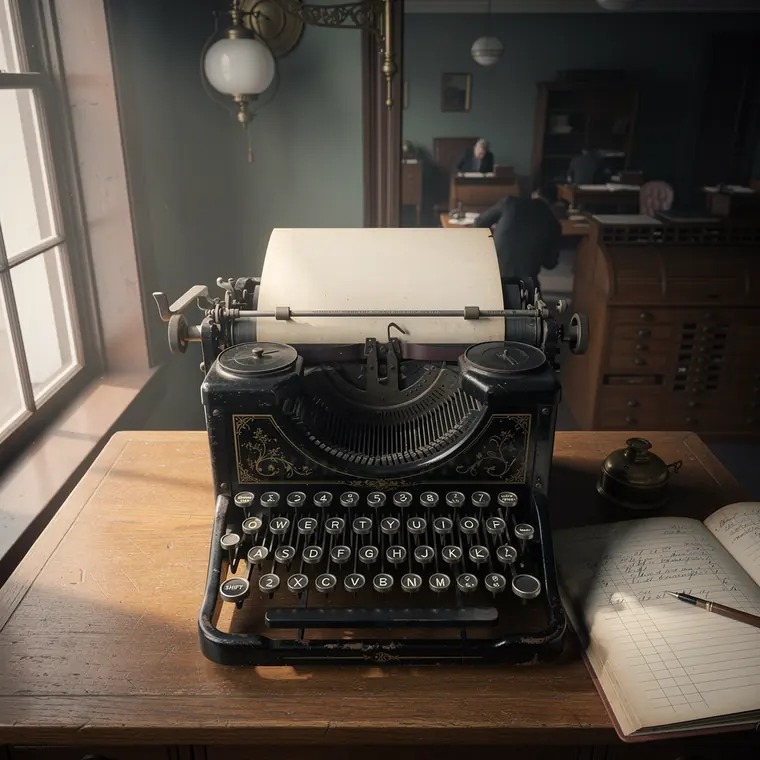
A heavy black typewriter with a shift key at the left end of the keyboard, each key cap bearing a single capital letter, two characters on each typebar, the typebars hanging in a circle beneath the carriage, the carriage raised on its hinged rails so its underside shows, a japanned frame with a gilt ornamental transfer of scrolls and lines across the front plate, a plain sheet of paper rolled round the platen, the machine on a flat oak desk beside a tall window on the left, a gas bracket with a frosted globe on the wall, an open ledger and a brass inkwell at the desk edge, roll-top desks and a tall pigeonhole cabinet further into the room, the far end of the office dim, dark unlit figures bent over the distant desks.
- What it was used for
- The Remington No. 2 was the machine with which the typewriter became office equipment. It was built by E. Remington & Sons at Ilion, New York, from 1878. Outwardly it kept its predecessor's principle: the type bars strike upward against the platen and the line written is hidden. The keys lay in four banks in QWERTY order. What was new was the shift. Each type bar now carried two types, a capital and a small letter; a lever moved the platen so that the second type struck. The machine thus wrote upper and lower case without the number of keys growing. On the record of the Smithsonian National Museum of American History, the commercial success of this machine led to QWERTY being adopted as a standard.
- What was new
- What was not new was printing with type bars. What was new was doubling the character set without doubling the keyboard. The 1923 company history describes how it came about: from the platen-shifting device invented by Lucien S. Crandall and the double-faced type bars of Byron A. Brooks. The rival answer stayed on the market for decades: a separate key for every character, as on the Caligraph of 1882. The barb lies in the key order. On the Smithsonian's account QWERTY was meant above all to keep the type bars from jamming; the upward-striking construction disappeared, the arrangement stayed. And in 1881 the business was still small: twelve hundred machines in the year.
What the sources leave open: The priority claim for the shift rests on the 1923 company history, a commemorative volume of the Herkimer County Historical Society, from Remington's home town of Ilion; no independent confirmation was found in this run. The Smithsonian record misleadingly calls the machine "the first commercial typewriter" and does not address the shift; it has been used here only for the statement about QWERTY. Production figures for the model were not found.
Connections
Every connection names its kind. “Forerunner” on its own would be a claim.
- Follows fromSholes & Glidden Type-Writer1874Industrial production began in 1873 with the Sholes & Glidden machine at Remington. In 1878 the same firm launched its Model No. 2, which introduced the case shift between capitals and small letters - the successor from the same house.Source: Heinz Nixdorf MuseumsForum: Typewriters - from the idea to a standard · Wisconsin 101 (University of Wisconsin, Archivfassung): Object History - Sholes & Glidden Typewriter