Caligraph No. 2
1882 · Double Keyboard · Work 524 of 1,871
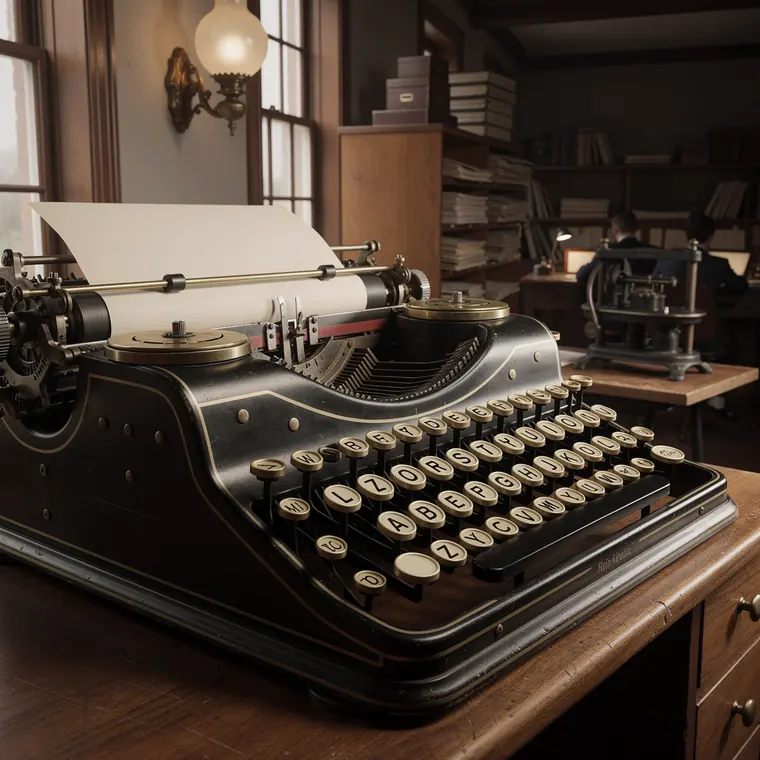
A typewriter with an enormous keyboard of seventy-two keys rising in six curved banks, the rows stepped up like a small amphitheatre, each key cap bearing a single capital letter, the upper banks for capitals and the lower banks repeating the same letters in small form so every letter has its own key, a single wide space bar at the bottom, the typebars standing in a ring under the raised carriage, the frame black with thin gilt lines, a plain sheet of paper in the platen, the machine on a flat desk under a tall window on the left, a gas globe on a wall bracket above, a pigeonhole cabinet and a copying press on a side table, the office reaching back into shadow with slant-top desks in a row.
- What it was used for
- The Caligraph No. 2 was an office typewriter with a full keyboard: no shift key, but a separate key for every character, seventy-two in all - in one collection's description, black keys for the capitals and white ones for the small letters. It was built by the American Writing Machine Company in New York; the No. 1 had appeared in 1880, the No. 2 came in 1882. Behind the firm stood George Washington Newton Yost (1837-1906), who had previously sold Remington machines; Franz X. Wagner is named as its designer. The type bars struck upward against the underside of the platen - the line written was hidden until the paper moved on. The Museo Nicolis calls the Caligraph the third best-selling typewriter in the United States. The firm built typewriters until 1914.
- What was new
- What was new in this device was its answer to a question still open in 1882: how do upper and lower case get onto the same machine? Remington had chosen the shift in 1878, one key for two characters. The Caligraph chose the opposite, one key per character - no shifting, nothing to hold down, but a keyboard across which the hands must travel. Which answer was better the market took decades to decide. The barb: the machine was praised for delivering every character at a single stroke - and none of them could be seen while typing. And its designer Franz X. Wagner later built the visible-writing machine that, as the Underwood No. 5, drove such devices out of the office.
What the sources leave open: The figure of seventy-two keys and the black/white assignment come from collection descriptions (SLK Museo, Martin Howard Collection), not from the maker. The Martin Howard Collection calls the Caligraph 2 the first machine with a double keyboard (unconfirmed). "Third best-selling" is a statement by the Museo Nicolis with no number attached. That the 1880 No. 1 did not yet write small letters is implied by these descriptions but not stated, so it is not asserted here.
Connections
Every connection names its kind. “Forerunner” on its own would be a claim.
- Follows fromRemington No. 21878The Museo Nicolis names George Yost, "promoter and manufacturer of the Remington", as co-inventor of the Caligraph (1880); its No. 2 of 1882 was made under his supervision. According to the Heinz Nixdorf MuseumsForum, the competition answered the Remington No. 2's case shift with keyboards having separate keys for capitals and small letters.Source: Museo Nicolis, Verona: Caligraph, 1882, N°2 · Heinz Nixdorf MuseumsForum: Typewriters - from the idea to a standard