The Mimeograph
1887 · Rotary Stencil · Work 539 of 1,871
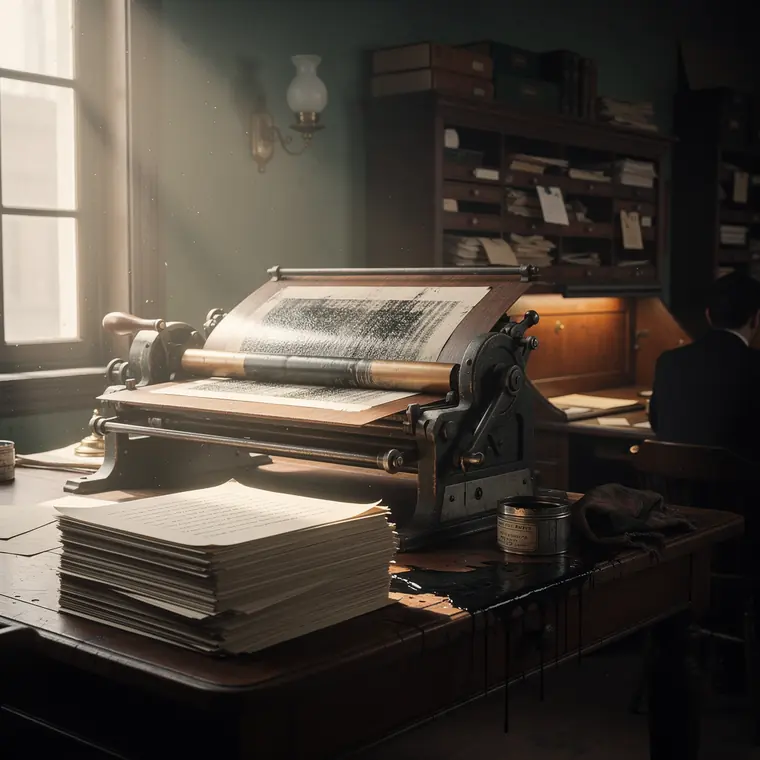
A flatbed duplicator with a hinged wooden frame, an inked stencil stretched across the frame, a hand roller resting at one end, a stack of finished sheets squared beside the machine, the sheets bearing faint lines of duplicated type, ink smeared along the edge of the table, an ink tin and a rag beside, the table beneath a tall window on the left, a gas bracket with a frosted globe on the wall, a slant-top desk and a tall pigeonhole cabinet behind, the office fading into shadow with dark unlit figures at the far desks.
- What it was used for
- The Edison Mimeograph of the A. B. Dick Company, Chicago, was a stencil duplicator with no electricity. A wax-coated stencil sheet lay on a finely grooved steel plate and was written on with a smooth pointed steel stylus; the grooves perforated the writing from below in holes so close together that the dividing fibres of paper were scarcely perceptible. The stencil was then held taut in the printing frame and a roller, inked on a slate, drawn over it. One documented buyer: the Circuit Court Clerk's office of Chesterfield County, Virginia, bought an Edison Mimeograph Model No. 1 for $15 around 1890; the kit still holds ink tubes, stylus, roller and empty solvent bottles. The Library of Virginia itself says only that it "may have been" used for copies of notices, and points out that nitrocellulose and the benzine used for cleaning were highly flammable.
- What was new
- The Mimeograph cut its stencil with no battery and no motor, removing the wet cell that had held back sales of Edison's pen. The method itself was not new: Zuccato's Trypograph already pierced the wax stencil from below on a file plate in 1877, and Edison patented a similar method in 1880. David Gestetner's Cyclostyle wheel pen of 1881 was, on the Early Office Museum's account, superior to Edison's pen precisely because it needed no battery and produced better stencils. On the drum machine A. B. Dick was two years late: the Neostyle Co. marketed the first rotary stencil duplicator in 1898, A. B. Dick sold Rotary Mimeographs from 1900. The barb is a judgment. A "License Restriction" was fixed to the machine: it might be used only with stencil paper, ink and other supplies made by the A. B. Dick Company. On 11 March 1912, in Henry v. A. B. Dick Company, 224 U.S. 1, the Supreme Court held that even selling a can of ink to an owner, knowing of the restriction, was contributory infringement - four votes to three, with one justice dead and one absent. Congress answered on 15 October 1914 with section 3 of the Clayton Act, and on 9 April 1917 the Court overruled itself.
What the sources leave open: The sources differ on what kind of date 1887 is: taking a licence on Edison's patents (Library of Virginia), release of the model "0" flatbed (Princeton), the start of manufacturing and marketing (Early Office Museum, which says "acquired" rather than "licensed"). No trademark registration for "Mimeograph" could be found, nor a patent number for Dick's wax stencil. No source opened states that schools, churches or armies were buyers.
Connections
Every connection names its kind. “Forerunner” on its own would be a claim.
- Follows fromEdison's Electric Pen1876Albert Blake Dick licensed and refined Edison's patents. Edison's 1876 patent for "Autographic Printing" covered the electric pen and the flatbed press; a patent for "Autographic Stencils" followed in 1880. The 1887 No. 1 Mimeograph is lettered "EDISON / MIMEOGRAPH" and "MADE ONLY BY A.B. DICK CO.", Chicago.Source: The Henry Ford: Edison No. 1 Mimeograph, 1887
Further reading
- Library of Virginia, UncommonWealth: Edison Mimeograph Model No. 1, Chesterfield County
- Princeton University Library, Graphic Arts: The Edison Mimeograph
- Early Office Museum, Antique Copying Machines (Mimeograph, Neostyle 1898, Rotary 1900)
- Henry v. A. B. Dick Company, 224 U.S. 1 (1912), amtliche United States Reports
- Motion Picture Patents Co. v. Universal Film Mfg. Co., 243 U.S. 502 (1917), amtliche United States Reports
- US-Patent 538.663, Albert B. Dick, Stencil-Printing Machine (1894/1895)