Glaspalast Muenchen
1854 · Iron and Glass Framing · Work 56 of 1,871
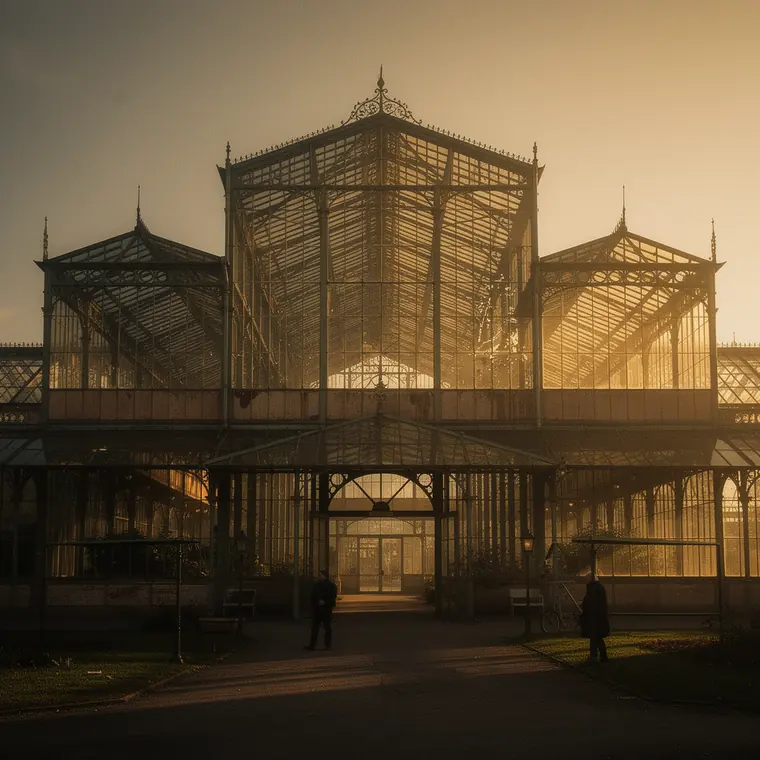
The Glaspalast in Munich standing in the old botanical garden, a three-aisled iron and glass hall with a raised central nave and slender riveted trusses spanning the exhibition floor.
- What it was used for
- Built for the first General German Industrial Exhibition in the Old Botanical Garden and opened on 15 July 1854; architect August von Voit, with the ironwork supplied by the Cramer-Klett engineering works in Nuremberg. The building contract is dated 11 September 1853 and the building was finished in the summer of 1854 - about nine months. It used more than 37,000 sheets of glass and some 1,700 tons of cast iron. The exhibition drew 6,798 exhibitors and just under 200,000 visitors; it suffered from the cholera outbreak that struck Munich in the summer of 1854 and killed Queen Therese on 26 October. Afterwards the building served for 77 years as the exhibition hall of the Munich artists' association and the Secession. On the night of 6 June 1931 it burned out completely. Some 3,000 works of art burned with it, among them the exhibition "Works of German Romantics", opened five days earlier, with 110 paintings.
- What was new
- The building followed London's Crystal Palace of 1851 but reversed its most important property: London was conceived as a movable structure and was indeed dismantled and re-erected, whereas Munich stayed on the same site for 77 years and became a permanent exhibition house. What was new on the continent was the method: a fully prefabricated, standardised glass-and-iron structure on a grid of 20 Bavarian feet (5.84 m), whose iron frame was erected in about two months. Whether it was the largest glass-and-iron building on German soil is stated explicitly by none of the sources checked; only the order of magnitude is documented, through the quantities of material. The sting came in 1931: the building was held to be incombustible. The police suspected spontaneous combustion of soaked cleaning rags; the Upper Bavarian government recorded arson - a classification that relieved the state of compensation. The cause was never established.
Connections
Every connection names its kind. “Forerunner” on its own would be a claim.
- Follows fromCrystal Palace1851The Historisches Lexikon Bayerns names the model outright: Voit chose a prefabricated, standardised glass and iron structure on a grid "in Anlehnung an den Crystal Palace in London". The Nuremberg works Cramer-Klett built it.Source: Historisches Lexikon Bayerns: Glaspalast, München · Zentralinstitut für Kunstgeschichte, MunichArtToGo: Der Glaspalast
Further reading
- Historisches Lexikon Bayerns: Glaspalast, München
- Haus der Bayerischen Geschichte: Glossareintrag Glaspalast München
- Zentralinstitut für Kunstgeschichte / MunichArtToGo: Der Glaspalast (37.000 Glastafeln, 1.700 t Gusseisen, 110 Gemälde)
- Statistisches Amt München, Münchener Statistik 9/1967: Messen und Ausstellungen in München (6.798 Aussteller, rund 200.000 Besucher)
- Bayerische Staatszeitung: Ein Meisterwerk seiner Zeit (Bauzeit, Brandursache, Entschädigungsfrage)
- Bayerische Schlösserverwaltung: Therese von Sachsen-Hildburghausen (Tod am 26.10.1854)