The Plugboard
1935 · Control Panel · Work 582 of 1,871
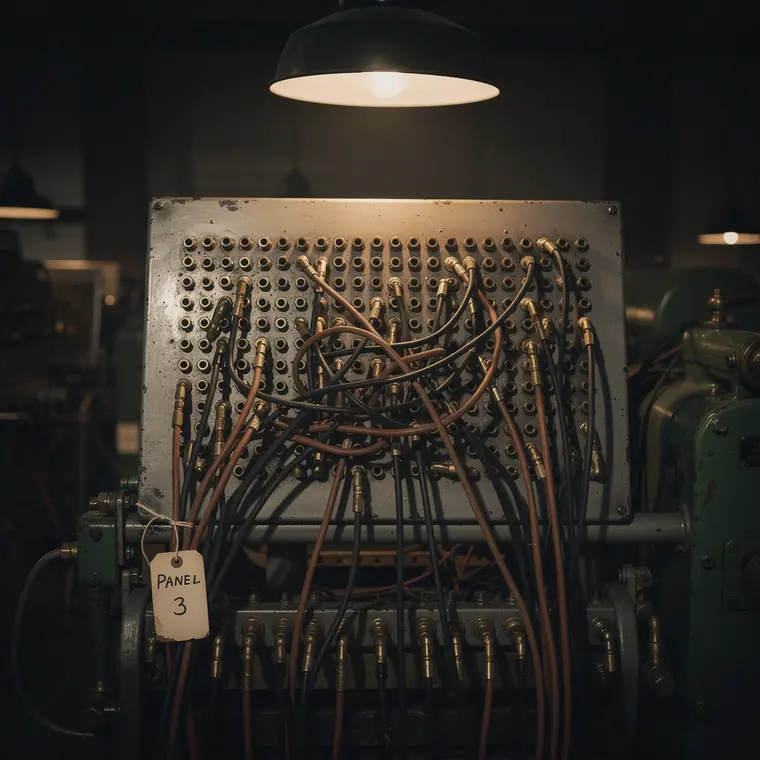
A removable control panel drilled with a grid of hundreds of small sockets, short patch cords looped between them in a dense tangle, the cord tips in brass, the cords in black and brown cloth insulation, a plain paper tag tied to one corner with string, the panel propped against the machine it fits, the sockets and cords close to the lens, the machine frame behind in soft focus, a machine room lit by pendant lamps, brass warm against grey enamel.
- What it was used for
- The control panel was the program of a punched-card machine: a removable board full of sockets, called hubs, between which wires were plugged. The wiring decided which card columns were read, which counter they fed, and where printing or punching happened. IBM's 1936 manual shows what this looked like on the Interpreter Type 550: two sets of hubs, one for the columns of the card, one for the 45 type bars. Whoever joined them decided which 45 columns were printed across the top of the card and in what order. A pre-wired board could be swapped quickly; the payroll machine became the inventory machine.
- What was new
- What was new was not the wiring but that it could be lifted out. According to Martin Campbell-Kelly, Hollerith's tabulators already had a plugboard among the improvements of 1905 to 1907, which allowed faster reconfiguration than physical rewiring. Genuinely fast, though, was the connection-box of the rival Powers machine, which Campbell-Kelly says allowed reconfiguration in a matter of seconds, while the C-T-R machine took much longer. The price of the solution: each type of machine had its own panel, so a program could not be moved, and it was not text but a bundle of wires. Computing courses later printed control-panel templates on blackboards so that programs could be sketched in chalk.
What the sources leave open: The dating contradicts itself within one source: Columbia University's tabulator page names the 1925 Type 3-S as the first model with a removable plugboard, while its plugboard page gives 1928 as the start. No evidence for 1935 was found; in IBM's 1935/36 manual the control panel is already standard. No figure for the number of hubs per panel was found.
Connections
Every connection names its kind. “Forerunner” on its own would be a claim.
- Works withIBM 285 Electric Tabulator1933The tabulator knows no task of its own. Only the plugboard tells it which column goes where: "Users wired plugboards to specify exactly which card columns were to be read or punched." Columbia shows the panel of its own Type 285 of 1933 and calls it "relatively simple".Source: Plugboards - Columbia University Computing History · IBM 285 Electric Tabulator - Columbia University Computing History