The Recirculating Loop
1948 · Dynamic Storage · Work 602 of 1,871
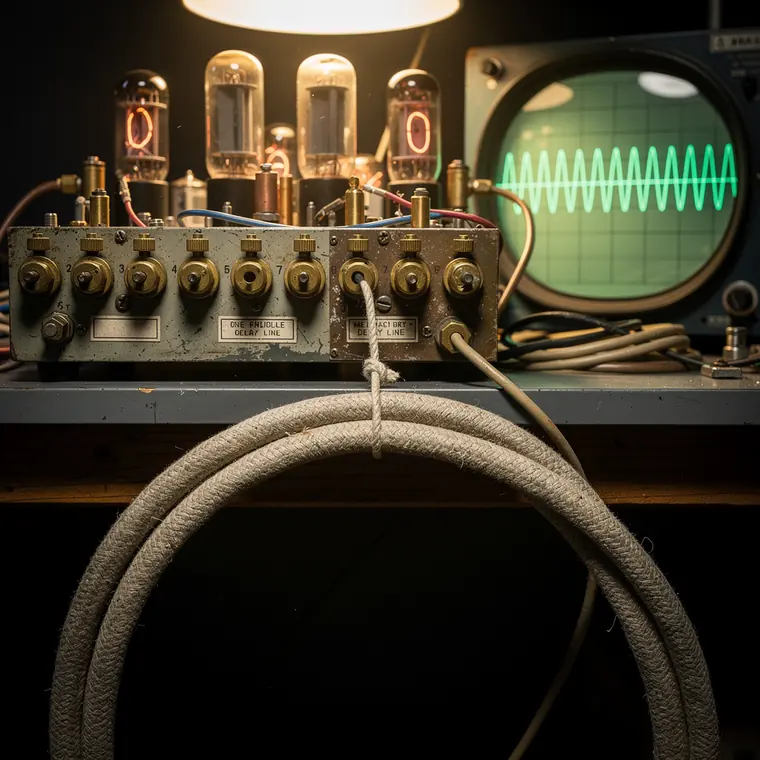
The output of a mercury delay line wired back into its own input through a valve amplifier on an open chassis, the loop of coaxial cable hanging in a clear arc above the bench, the glass envelopes of the valves glowing faintly orange, a small round oscilloscope face beside the chassis showing a train of evenly spaced pulses as a bright green trace, brass terminal posts and cloth-covered wire, seen close so the cable arc and the pulse trace fill the frame, one soft light from behind the oscilloscope, everything else falling away into pure black.
- What it was used for
- Recirculation was the form this store took: the bits ran through a line as sound pulses, were picked up at the far end, amplified, reshaped, put back on the clock and fed in again at the start. The University of Melbourne describes it for Australia's CSIRAC in one sentence: "The modulated pulse was detected, amplified, re-shaped and re-generated, being fed back into the beginning of the tube." The content was thus not a state but a motion. Access meant waiting until the wanted word came round; the 1949 paper by Auerbach, Eckert, Shaw and Sheppard states it plainly: "On the average, the access time will be one-half the recirculation time." That is why short lines were built beside the long ones. The Pilot ACE had, per the Computer Conservation Society, "five single-word delay lines, called temporary stores" as registers.
- What was new
- What was new was a store that exists only while it runs. The principle was in John von Neumann's 1945 draft: "Since dl is to be used as a memory its output must be fed back—directly or indirectly—into its input." The engineering version came from Auerbach, Eckert, Shaw and Sheppard, whose manuscript reached the Institute of Radio Engineers on 15 December 1948: each circulation uses a fresh, clean pulse that the old one merely gates through — "Each recirculation therefore uses a new pulse gated into the line by the previous pulse." The barb: a longer line stores more but means a longer wait; the same paper advises that "column length should be kept short in the interests of access time". And the content hangs on the mains: "The process is repeated indefinitely, unless the line is cleared by interrupting the recirculation path or a power failure occurs."
What the sources leave open: For 1948 only designs, experimental tanks and the submitted manuscript are documented; the EDSAC first ran on 6 May 1949. The quotations from the 1945 EDVAC report and the 1949 paper come from the originals; the Pilot ACE and DEUCE figures from the Computer Conservation Society.
Connections
Every connection names its kind. “Forerunner” on its own would be a claim.
- Works withMercury Delay Line1947The recirculating loop is the electrical half of the mercury store. In CSIRAC the pulse travelled 960 microseconds down the tube, was picked up at the far end, "detected, amplified, re-shaped and re-generated" and fed back into the beginning of the tube. The number stays in circulation "until accessed or changed by the computer".Source: CSIRAC: Our first computer - School of Computing and Information Systems, University of Melbourne · 1949: EDSAC computer employs delay-line storage - Computer History Museum, Storage Engine
Further reading
- CSIRAC: Our first computer, School of Computing and Information Systems, University of Melbourne
- Auerbach, Eckert, Shaw, Sheppard, Mercury Delay Line Memory Using a Pulse Rate of Several Megacycles, Proceedings of the I.R.E., August 1949
- John von Neumann, First Draft of a Report on the EDVAC, 30. Juni 1945
- Architecture of the English Electric DEUCE computer (mit Pilot ACE), CCS-N1X2, Computer Conservation Society, August 2011
- EDSAC 99, University of Cambridge Computer Laboratory