The Temperature Bath
1949 · Thermal Regulation · Work 603 of 1,871
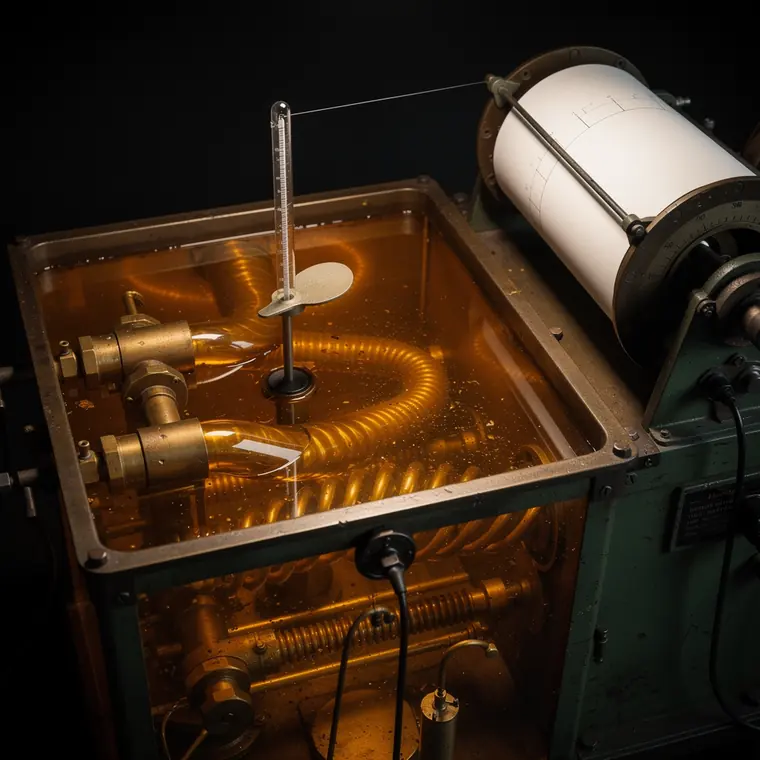
A mercury delay line submerged in a rectangular oil bath, the oil amber and still, a mercury-in-glass thermometer standing upright in it with a fine silver thread in the bore, a slow paddle stirrer on a vertical shaft, a chart recorder beside the bath with its pen drawing a nearly flat line on a slowly turning paper drum, brass fittings of the line showing warm through the oil, seen close so the bath and the recorder drum fill the frame, a single soft light from behind the bath passing through the amber oil, deep black all around.
- What it was used for
- The speed of sound in mercury depends on temperature, and so the length of the store depends on its warmth. Engineering Research Associates' 1950 handbook gives the order of magnitude: the velocity changes "about 1 part in 3,000 for each degree centigrade change in temperature" — with 3,000 bits in a line, if you do not know the temperature to within a degree you read the bits correctly and still cannot tell which bit is passing. That is why every UNIVAC I tank sat in a heated jacket. The Computer History Museum describes the mercury as "held at a constant 149ºF" — 65 degrees Celsius. There were two heating systems: a 230-ohm alternating-current coil brought the tank roughly up to temperature, a 3,500-ohm direct-current coil held it finely. By the maintenance manual it took about three quarters of an hour for all tanks to come up to heat.
- What was new
- What was new was a store heated according to its own transit time. One of the 18 channels in each tank carried no data: "Channel 18 is the temperature-control channel", and it regulates the heating from the result of a measurement — "the temperature-control channel, which measures the transit time of a pulse through the mercury". The 1949 paper names the reversal in this: in the proposed designs of earlier computers the clock had been trimmed to the temperature of the mercury; now a crystal-controlled oscillator sets the time, "which in turn controls the mercury temperature, and hence controls the circulation time of the tanks". The price: seven of 126 channels went on measuring the machine's own warmth, and an overheat switch took not only the heating but the computer with it — "The overheat switch cuts off a-c heat to all tanks, cuts off d-c power to the computer".
What the sources leave open: The widely quoted 40 degrees Celsius does not apply to the UNIVAC I: its maintenance manual gives 65 degrees and the Computer History Museum 149 degrees Fahrenheit. Forty degrees is documented for CSIRAC in Melbourne, whose heated box was called "the coffin". The 1949 paper gives the tolerance as "±0.3° absolute", not ±0.1 degree. No EDSAC set-point was found in a primary source.
Connections
Every connection names its kind. “Forerunner” on its own would be a claim.
- Works withMercury Delay Line1947The mercury tubes were held at an even temperature. In CSIRAC they sat in a wooden box "affectionately referred to as the coffin", with a heater inside that kept them "at a constant temperature of about 40 degrees Celsius". In EDSAC the lines were long steel tanks "filled with mercury".Source: CSIRAC: Our first computer - School of Computing and Information Systems, University of Melbourne · Delay line storage in EDSAC - pick your poison - The National Museum of Computing
Further reading
- UNIVAC I mercury memory tank (X976.89), Computer History Museum
- UNIVAC I Mercury Delay Line Memory (Transkription des UNIVAC I Maintenance Manual), ed-thelen.org
- Engineering Research Associates, High-Speed Computing Devices, McGraw-Hill 1950 (bitsavers)
- Auerbach, Eckert, Shaw, Sheppard, Mercury Delay Line Memory Using a Pulse Rate of Several Megacycles, Proceedings of the I.R.E., August 1949
- How did CSIRAC work?: Storage, University of Melbourne (archiviert Juli 2025)
- Remington Rand Univac, Maintenance Manual for Use With Univac I Central Computer (bitsavers, Fassung Jan. 1958)