The Regeneration Cycle
1948 · Refresh · Work 609 of 1,871
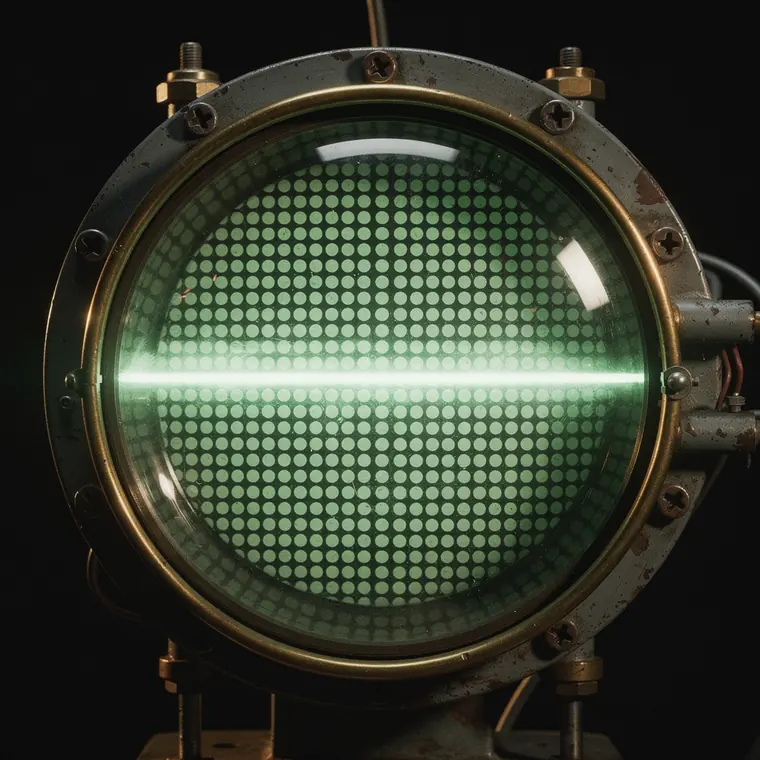
The face of a Williams storage tube caught as the beam sweeps across the stored pattern to read and rewrite it, a bright horizontal line crossing the grid of dots mid-sweep, the rows of dots behind the line freshly bright and sharp, the rows ahead of it dimmer and slightly blurred, the grid filling the tube face edge to edge, the green phosphor glow the sole light, a faint reflection of the sweep line on the glass, the tube face alone against pure black.
- What it was used for
- The regeneration cycle was the beat in which the tube store rewrote itself. According to the University of Manchester's description the charge on the screen would have drained away in tenths of a second, so every line had to be read and written back at once, faster than it decayed. In the Baby of 1948 one instruction consisted of four equal beats of 306 microseconds each. Two of them were scan beats: they refreshed one line after another. The other two fetched and executed the instruction. The whole store of 32 lines was thus worked through once every 16 instructions. The clearing key on the console needed about 20 milliseconds, one full raster period, to erase everything.
- What was new
- In the Baby the machine's beat was built around the store. The store did not follow the machine; the machine followed the decay of a charge. Instruction length, beat length and the order of accesses were fixed because the refresh had to fit between them. That is the price dynamic memory still pays today, and here it was in plain sight: half the beats belonged to remembering, and in them the machine could only do work that needed no store access. How tightly store and rewriting were bound together is shown by the clearing key: it broke the regenerative loop, and after about 20 milliseconds, one raster period, the store showed nothing but zeros - faster than the charge would have leaked away by itself.
What the sources leave open: The figure that the clearing key acts in about 20 ms over one raster period comes from the original paper by Williams, Kilburn and Tootill. The paper also states that it does so by breaking the regenerative loop.
Connections
Every connection names its kind. “Forerunner” on its own would be a claim.
- Works withWilliams-Kilburn Tube1947The charge on the phosphor leaked away in the order of a second. The tube held anything at all only because the values were read and rewritten without pause: "values were preserved indefinitely by continuously reading their value and resetting the charge". Williams arranged it so; the process was called "regeneration".Source: History of the Williams-Kilburn Tube - University of Manchester, digital60 archive · The Baby - Mark 1 Story, University of Manchester computer50 archive