The Monitor Tube
1949 · Visible Memory · Work 611 of 1,871
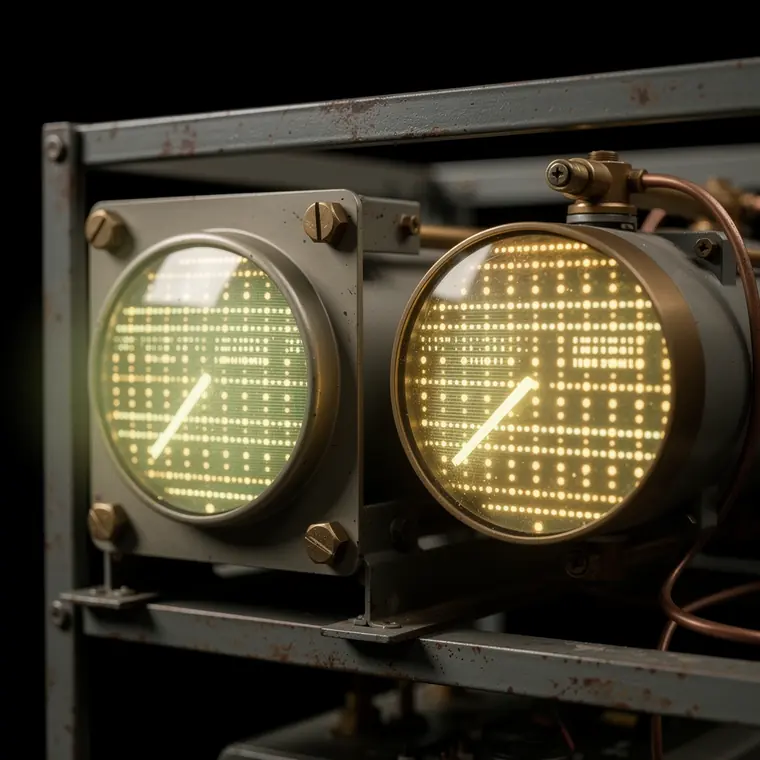
A small round display tube in a plain metal housing mounted on a rack beside a larger storage tube, its face showing the same grid of bright dots and dashes as the storage tube, a thin grease-pencil mark on the glass beside one position in the grid, the two tube faces side by side with the phosphor pattern reflected faintly in the grey metal of the rack, seen close so the small tube face and the pencil mark fill the frame, the phosphor glow and a single soft light from behind, the rack fading into pure black beyond.
- What it was used for
- The monitor tube was the screen at the console of the Manchester machines. It showed a copy of the contents of a selected storage tube: bright spots for ones, dim spots for zeros. It was needed because the storage tube itself showed nothing - the pick-up plate sat in front of its screen, and to shield it from interference, from passing trams among other things, it was enclosed in a metal box. On the Ferranti Mark 1 it displayed 32 rows of 40 digits, arranged in groups of five to match the five-hole paper tape. Until a tape punch was attached, reading this tube was the Manchester Mark 1's only output. Input came from a keyboard that set the contents of the store directly.
- What was new
- The state of the store was visible all the time. Not a printout afterwards, but the running contents: whoever worked the machine watched it compute. A second tube was needed purely for looking, because the first one was built over. And the picture was arranged for operators working with paper tape: the least significant digit on the left, the bits grouped in fives because the paper tape had five holes. The picture could be read only by someone who had learned to read numbers backwards and in the order of the tape.
Connections
Every connection names its kind. “Forerunner” on its own would be a claim.
- Works withWilliams-Kilburn Tube1947The contents of a storage tube could not be read off directly, because the pick-up plate covered the screen. The Baby therefore carried "a fourth tube, the Display Tube", which could be switched to any of the Williams-Kilburn tubes and was "updated synchronously with the refresh cycle".Source: History of the Williams-Kilburn Tube - University of Manchester, digital60 archive · The Baby - Mark 1 Story, University of Manchester computer50 archive