The Access Arm
1956 · Head Positioning · Work 617 of 1,871
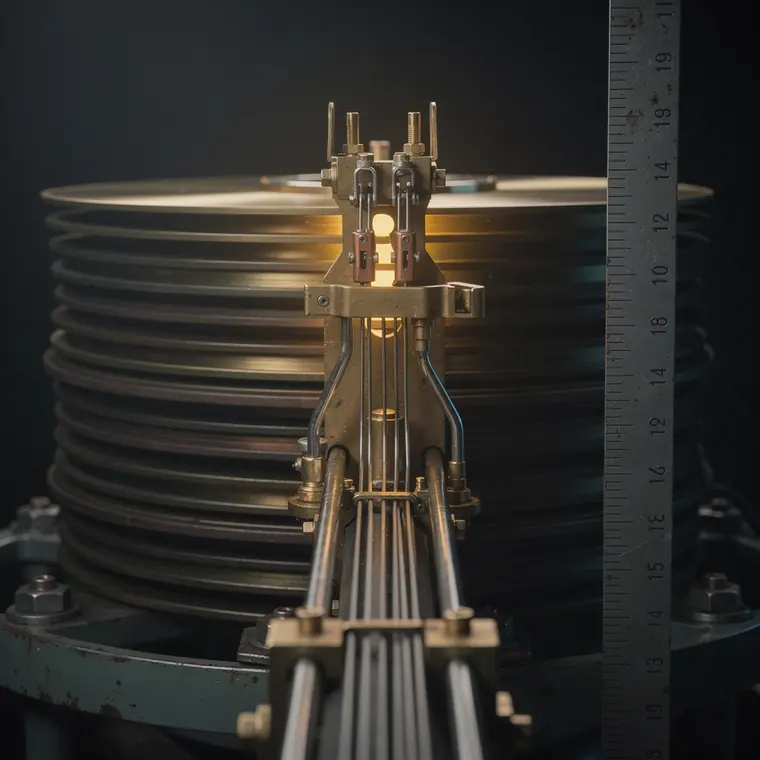
A mechanical access arm on steel rails driven vertically between the stacked disk platters, its forked tip carrying a pair of heads, hydraulic lines running along its length in tight parallel runs, a plain graduated scale fixed beside its travel with evenly spaced engraved marks, the rails polished by use, the platters behind the arm in even horizontal layers, seen close so the arm and the rails fill the frame, a single soft light from behind the platter stack silhouetting the arm, warm brass fittings against desaturated grey steel, pure black beyond.
- What it was used for
- The access arm of the IBM 350 was the only moving path to five million characters. According to Hoagland, one arm-and-actuator assembly carried a pair of heads, one for the upper and one for the lower surface of a disk. The arm first travelled vertically to the chosen disk in the stack, then horizontally inward to the required track, and afterwards withdrew. A servo drive controlled it. On average 600 milliseconds passed before a record was reached. The arm was therefore not an accessory but the machine: it turned a stack of rotating disks into a store in which any address could be reached.
- What was new
- The decisive step was doing without a head per surface. A hundred written sides shared a single pair of heads that travelled back and forth between them. That is what made the disk unit affordable at all - and at the same time created the bottleneck: every access had to wait for the arm to withdraw and travel out again, 600 milliseconds on average, and two accesses at once were impossible. The sister unit 355 had several actuators, according to Gardner, and was more expensive for it. The standard for the industry was set by the IBM 1301, announced in 1961, where a comb-like carrier held one slider over every disk surface and the journey between disks fell away.
Connections
Every connection names its kind. “Forerunner” on its own would be a claim.
- Works withIBM 350 Disk Stack1956The access mechanism travels vertically along a way to the selected disk in the stack, is locked there by a pneumatic detent and then frees the arms for radial motion: "The arms move inward to straddle a selected disk during reading or writing."Source: Noyes & Dickinson, The Random-Access Memory Accounting Machine. II. The Magnetic-Disk, Random-Access Memory, IBM Journal of Research and Development 1957 (ETHW)
- Works withThe Flying Head1956The head sits in the arm, in a gimbal mount: "The head is horizontally constrained in a gimbal socket in the arm." The access mechanism "is used to position the pair of heads to any track on the disk array"; at the track the air bearing then holds the gap of a thousandth of an inch.Source: Noyes & Dickinson, The Random-Access Memory Accounting Machine. II. The Magnetic-Disk, Random-Access Memory, IBM Journal of Research and Development 1957 (ETHW)
Further reading
- A. S. Hoagland: History of Magnetic Disk Storage Based on Perpendicular Magnetic Recording, IEEE Transactions on Magnetics 39(4), Juli 2003, S. 1871-1875
- ASME Landmark: IBM 350 RAMAC Disk File (Engineering and Technology History Wiki)
- 1961: Flying heads improve HDD capacity and speed (Computer History Museum, Storage Engine)
- Tom Gardner: Myths About IBM RAMAC, First HDD (ed-thelen.org)