The Wiring Room
1955 · Core Threading · Work 622 of 1,871
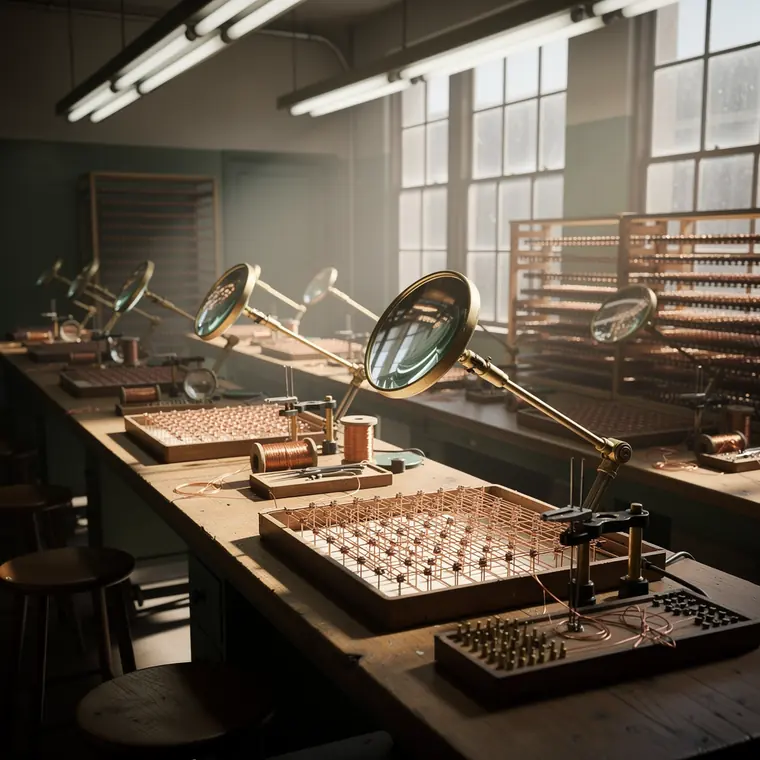
A long bright assembly room with a row of plain wooden benches, at each place a magnifier lens on an adjustable stand, a shallow tray of tiny ferrite rings, a spool of fine copper wire and a threading needle in a pin vice, a stool pushed under each bench, finished core planes stacked upright in a wooden rack at the end of the row, tubular fluorescent lights along the ceiling and tall windows down one wall, the benches empty and quiet, the room seen from bench height along the row so the benches fill the frame, the far end of the room fading into deep shadow.
- What it was used for
- The wiring room was where the core memories of the 1950s were made. A core memory is a grid of tiny ferrite rings; each ring holds one bit, and wires have to be drawn through every ring. A common plane carried 64 by 64 rings, that is 4,096 of them, each threaded by four wires. The Computer History Museum describes the work as delicate hand assembly, mostly done by women using microscopes, who threaded thin wires through holes about the diameter of a pencil lead. IBM's first commercial core unit rested on such planes: the Model 737 was announced on 1 October 1954 and rented for 6,100 dollars a month, for 4,096 words of 36 bits.
- What was new
- What was new was not the room but the ratio: the memory that swiftly swept away its rivals could at first only be made by hand. According to Bashe and others, quoted by the computer museum of the University of Amsterdam, threading the wires of a 64 by 64 plane took about 25 hours; mechanised threading later cut this to 12 minutes. The same page calls early hand weaving cumbersome and therefore expensive. The barb sits in those two figures: the mechanisation that made core memory cheap abolished the work the room existed for. An unnamed engineer, quoted by Rosner and others, recounts a factory visit around 1959 at which the manager said there was no machine that could do it.
What the sources leave open: The figures of 25 hours against 12 minutes come from a museum page that attributes them to Bashe and others; the original passage was not consulted. The factory visit around 1959 is reported in Rosner and others 2018 without a name and without a citation.
Connections
Every connection names its kind. “Forerunner” on its own would be a claim.
- Parallel toThe Weaving Shed1835Rows of identical workplaces, the same movement at each, predominantly women, paid by the piece. The shed of 1835 and the room of 1955 are the same room with different material.
Further reading
- Magnetic Core Memory - CHM Revolution, Computer History Museum
- Core Memory - Computermuseum, Universiteit van Amsterdam
- 1953: Whirlwind computer debuts core memory - Computer History Museum, Storage Engine
- Rosner u. a., Making Core Memory: Design Inquiry into Gendered Legacies of Engineering and Craftwork, CHI 2018
- IBM Announces the 737 Magnetic Core Storage Unit - History of Information