IBM 726 Tape Unit
1952 · Magnetic Tape Drive · Work 631 of 1,871
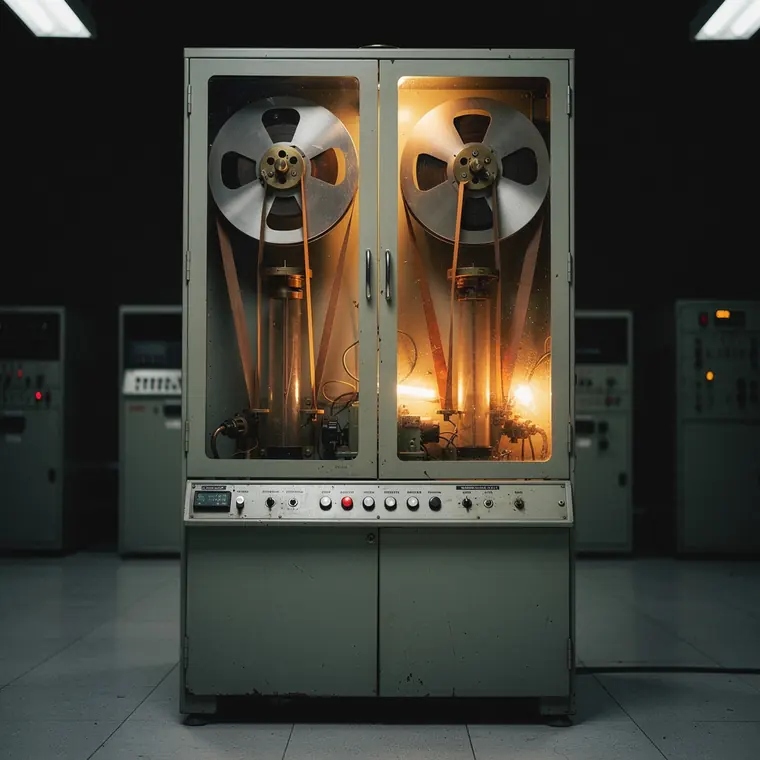
A free-standing tape unit of 1952 in a computer room, a tall sheet-steel cabinet painted plain grey, behind two glass doors in its upper half two tape transports side by side, each with two small metal reels of about twenty centimetres mounted next to each other, narrow brown half-inch tape running from each reel down into a pair of tall vertical glass-fronted vacuum columns where it hangs in long slack loops, a small row of plain round push buttons and pilot lamps below the doors, grey linoleum floor, further grey cabinets in soft focus behind, cool even ceiling light.
- What it was used for
- The IBM 726 was IBM's first magnetic tape unit, announced on 21 May 1952 together with the IBM 701 computer. It read and wrote half-inch tape at 100 bits per inch. In the IBM Journal paper by Bradshaw and Schroeder, Wayne Winger gives 7,500 characters per second and works out that this was 56 times faster than reading and writing punched cards at about 133 characters per second. According to Bradshaw and Schroeder, a reel 10.5 inches in diameter at 100 bits per inch held the equivalent of more than 35,000 punched cards. The 726 was shipped from 20 December 1952 to 28 February 1955.
- What was new
- What was new about the 726 was not tape in a computer; Eckert-Mauchly's UNISERVO was there in 1951. What was new was the combination of two things: coated plastic tape supplied by 3M to IBM's specification instead of metal tape, and the vacuum columns that let the tape stop quickly without tearing. Bradshaw and Schroeder write that IBM pioneered not only tape drives but half-inch tape itself; that dimension remained the reel format for decades. The barb lies in Bradshaw and Schroeder's figure: one reel replaced more than 35,000 punched cards, and IBM, as a veteran told the young engineers, was built on punched cards. With it came a loss of visibility. A hole in a card can be seen; a magnetisation cannot.
What the sources leave open: The statements about the reel contradict each other: Bradshaw and Schroeder give a diameter of 10.5 inches, the Computer History Museum 8 inches and two million digits per unit at 850 dollars a month. Neither source is Wikipedia; which reel size belongs to the 726 remains open.
Connections
Every connection names its kind. “Forerunner” on its own would be a claim.
- Works withThe Vacuum Column1953In the 726 the tape hangs in vacuum columns, buffers that let it start and stop quickly. James Weidenhammer, who invented the column, gave the reason: at the contemplated 100 to 200 inches per second the bulky reels could not be accelerated fast enough, so the tape path needed loops as buffers.Source: Computer History Museum, Revolution: IBM 726 magnetic tape drive (1952) · R. Bradshaw, C. Schroeder, Fifty years of IBM innovation with information storage on magnetic tape, IBM J. Res. & Dev. 47 (2003)