Hartree's Meccano Model
1934 · Model Analyser · Work 651 of 1,871
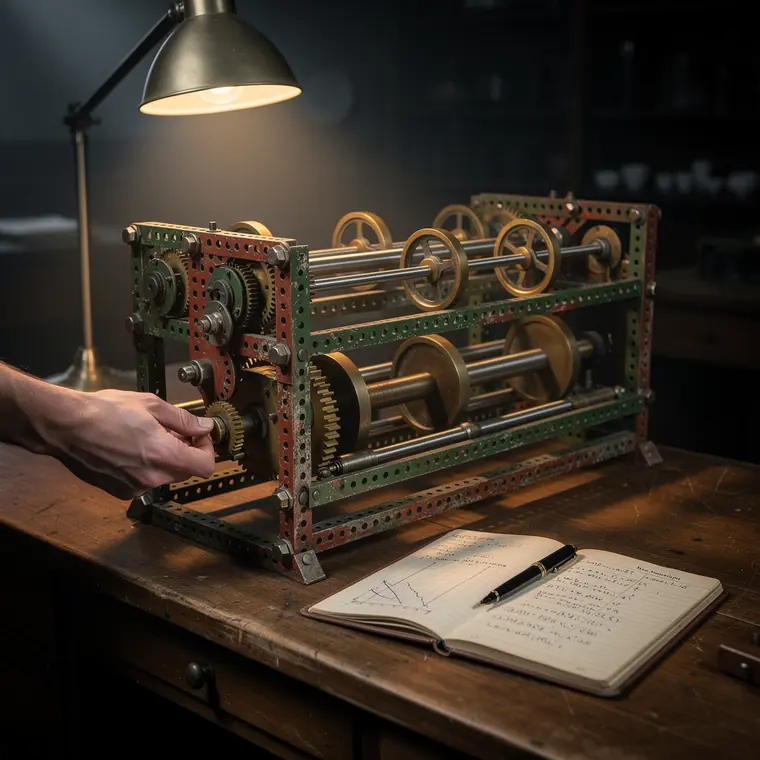
A working differential analyser built from painted perforated metal construction strips, brass gears and steel axle rods, a row of integrator units each a small disc with a wheel resting on it, shafts running the length of the assembly bolted together with small nuts and bolts, standing on a laboratory bench, entirely serious in function and plainly made from a toy, an anonymous hand adjusting one gear, every object of 1934 make, in a university physics laboratory, one bench lamp lit over the model, the laboratory beyond dark.
- What it was used for
- Douglas Rayner Hartree was a physicist in Manchester. In the summer of 1932 he travelled to MIT to see Vannevar Bush's differential analyser, in 1933 he used it there himself, and afterwards he built a model of it out of Meccano with his student Arthur Porter. The purpose was twofold: to compute and to advertise. According to the Dictionary of Scientific Biography the model was meant to raise money for a full-size machine. Porter built it in 1934, tested it first on the already known self-consistent field equations for hydrogen and then computed chromium, for which he received his master's degree. The model was afterwards used on a wide variety of problems. Hartree and Porter published "The Construction and Operation of a Model Differential Analyzer" in the Memoirs of the Manchester Literary and Philosophical Society, vol. 79, 1934–1935, pp. 51–72.
- What was new
- What was new was not the computing principle but the price. According to Tim Robinson's account the Meccano model cost about 20 pounds and reached an accuracy of about two per cent — enough to produce results that carried a master's degree. A differential analyser did not, then, have to be a large installation. The advertising worked: Sir Robert McDougall, deputy treasurer of the university, gave 6,000 pounds, Bush supplied plans and suggested improvements, Metropolitan-Vickers built it, and in March 1935 the full-size machine stood in the physics department at Manchester, first with four and shortly afterwards with eight integrators. The barb: for its real purpose it came too late. Hartree and Fock had by then refined their methods for the self-consistent field equations so far that desk calculators sufficed; with a grant from the DSIR, Hartree used the big machine for other things, among them dead time in process control.
What the sources leave open: The paper by Hartree and Porter was not read; the details come from the biography in the Dictionary of Scientific Biography. The cost and accuracy of the Meccano model (20 pounds, about two per cent) come from Tim Robinson, who builds such machines; no confirmation in the original paper or from a museum was found.
Connections
Every connection names its kind. “Forerunner” on its own would be a claim.
- Follows fromBush Differential Analyzer1931Douglas Hartree saw Bush's machine at MIT. On his return to Manchester University he set about a small-scale model built from Meccano, made in 1934 with the assistance of Arthur Porter.Source: Museum of Transport and Technology (MOTAT), Differential Analyser [Meccano; No.2]