The Rockefeller Analyzer
1942 · Electromechanical Analysis · Work 652 of 1,871
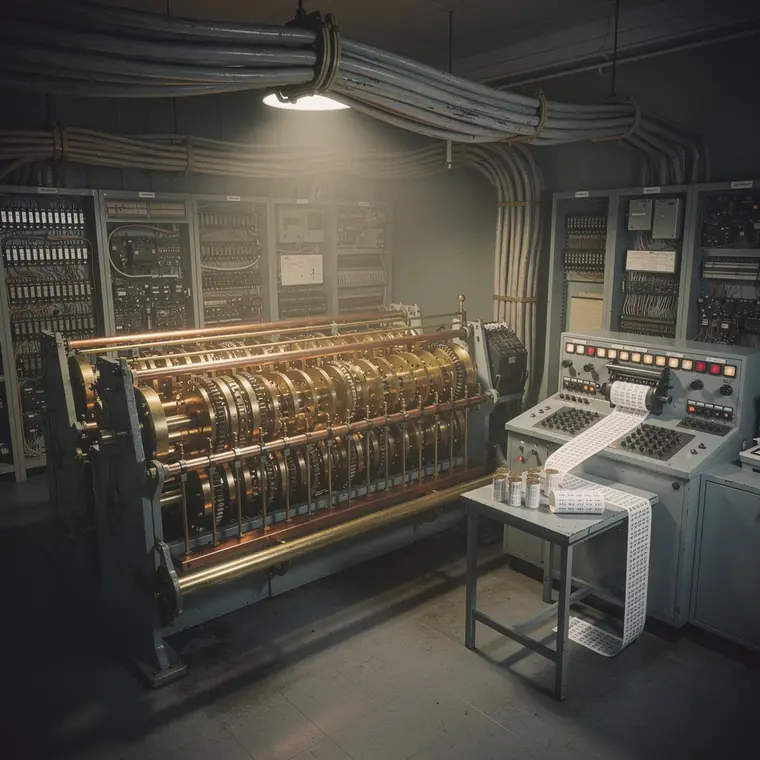
A room-sized machine of relay racks and shafted integrators, a long bed of shafts and integrator discs down the middle, tall racks of relays along the walls, cable trunks running overhead, its connections set by punched paper tape read in tape readers on a console at one end, tape reels waiting on a table beside the console, the machine grey painted steel with bright shaft ends, every object of wartime 1942 make, in a large university machine hall, one bank of overhead lamps lit above the console, the far end of the hall falling into darkness.
- What it was used for
- The Rockefeller Differential Analyzer was MIT's big calculating machine: a mechanical analogue computer that solved differential equations by having shafts, discs and wheels carry out the arithmetic physically. Larry Owens describes it as weighing almost a hundred tons, with several thousand relays, about a hundred and fifty motors and some two thousand vacuum tubes. Its first demonstration was on 13 December 1941, while it was still unfinished; about half of it was running by March 1943, and Owens writes that the function unit was still incomplete at the end of the war. It computed firing tables and radar antenna profiles. Owens, quoted by the Computer History Museum, calls it "the most important computer in existence in the United States at the end of the war".
- What was new
- The principle was not new. Vannevar Bush's first differential analyzer was solving problems by 1930/31, had six disc integrators and cost MIT about $25,000, according to Owens. On that machine the shafts had to be rearranged by hand for every new equation. The Rockefeller machine set itself up instead from punched paper tape and telephone relays, and it had more integrators than its predecessor, so it could take on harder problems with less setting-up time. The price was its size. It only became usable as its whole class of machine was ending: MIT had turned to digital machines by 1950, and the analyzer was not dismantled until 1954.
What the sources leave open: The sources give different funding figures: Owens has $10,000 (1935) and $85,000 (March 1936) from the Rockefeller Foundation, the Computer History Museum $230,500. Neither source gives the number of integrators, so it is left out.
Connections
Every connection names its kind. “Forerunner” on its own would be a claim.
- Follows fromBush Differential Analyzer1931The Rockefeller Analyzer was the larger successor at MIT to Bush's analyzer, built by Bush's group with a grant of 230,500 dollars from the Rockefeller Foundation. It held 18 integrators, and was set up by punched paper tape and telephone relays instead of rearranged shafts.Source: Computer History Museum, Revolution: Bush's Analog Solution · Differential Analyzers, Engineering and Technology History Wiki (IEEE)