The Dreyer Table
1911 · Fire Control Table · Work 660 of 1,871
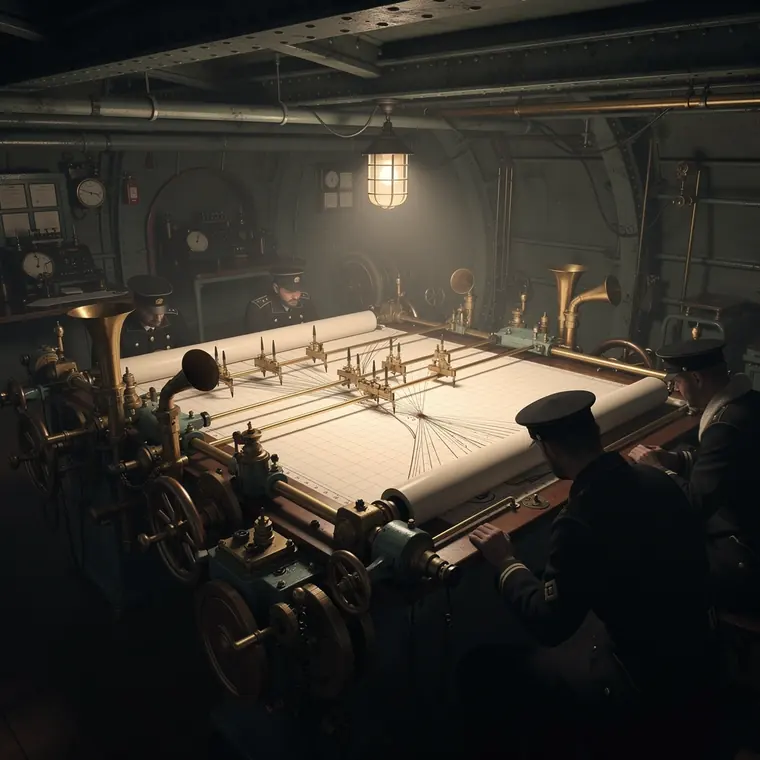
A large plotting table below decks carrying plotting paper on a moving roll, the paper ruled graph paper carrying a few drawn pen traces, several pens on carriages drawing simultaneous traces across the roll, handwheels and graduated dials with fine tick marks along the edge of the table, voice pipes with brass mouthpieces and telephone handsets ranged along its rim, anonymous operators seen from behind bent over the table, in the transmitting station of a battleship, riveted steel bulkheads, one caged electric lamp above the table, the compartment beyond dark.
- What it was used for
- The Dreyer table was the fire-control computer of British capital ships, installed in the transmitting station deep below decks. It plotted measured ranges and bearings against time on paper, derived the rates from them using a dumaresq and clockwork, and fed gun range and deflection continuously to the turrets. William Schleihauf calls it "an analogue computer, used to calculate the gun range and deflection, which would be transmitted to the guns", its driving principle being the plotting of range against time. The Dreadnought Project records a single original table in 1911, retrospectively designated "Mark II" in March 1914; the production marks came aboard between 1912 and 1922, from the hand-worked Mark I in older ships to the Mark V in Hood.
- What was new
- What the table could do was turn a cloud of inaccurate single readings into a usable rate. Instead of estimating the range, many readings were plotted against time, a mean line drawn through them, and the clock made to carry the range forward on that rate. Who had the idea is disputed, and the accounts differ in their verdicts: the Jutland Centenary site calls Arthur Pollen "probably" the inventor of the underlying idea and says Dreyer and Keith Elphinstone built their clock from the plans of the Argo clock, to which they had been given access; it calls this "questionable" and holds that the Admiralty was persuaded by the lower price. The barb lies in service: the Dreadnought Project says the bearing plot was "widely criticised" - quarter-degree steps, wandering gyroscopes, 120 degrees across the paper, so that moderate bearing rates gave shallow angles hard to measure - and that by 1919 it was agreed the range cuts were too sparse to yield a reliable rate. Schleihauf, by contrast, records that despite the criticism "it actually worked".
What the sources leave open: For the year 1911 the Dreadnought Project means not the Mark I but the single original table; the Mark I only came aboard in 1915/16. The same page calls the installation records explicitly "incomplete and at times unreliable". No overall production figures are given.
Connections
Every connection names its kind. “Forerunner” on its own would be a claim.
- Works withThe Dumaresq1902The Dumaresq with its Vickers range clock is one of the three primary elements of the Dreyer table. It relates the motion of own ship and target and the target bearing to the range rate. The rate set on the clock drives a worm screw that drags the pencil across the range plot; in the Mark I tables the clock was too weak, and an operator passed the motion on by handwheel.Source: The Dreadnought Project, Notizen zum Handbook of Captain F. C. Dreyer's Fire Control Tables, Admiralty C.B. 1456 (1918); Archivfassung vom 19.3.2016