The Link Trainer
1934 · Flight Simulation · Work 666 of 1,871
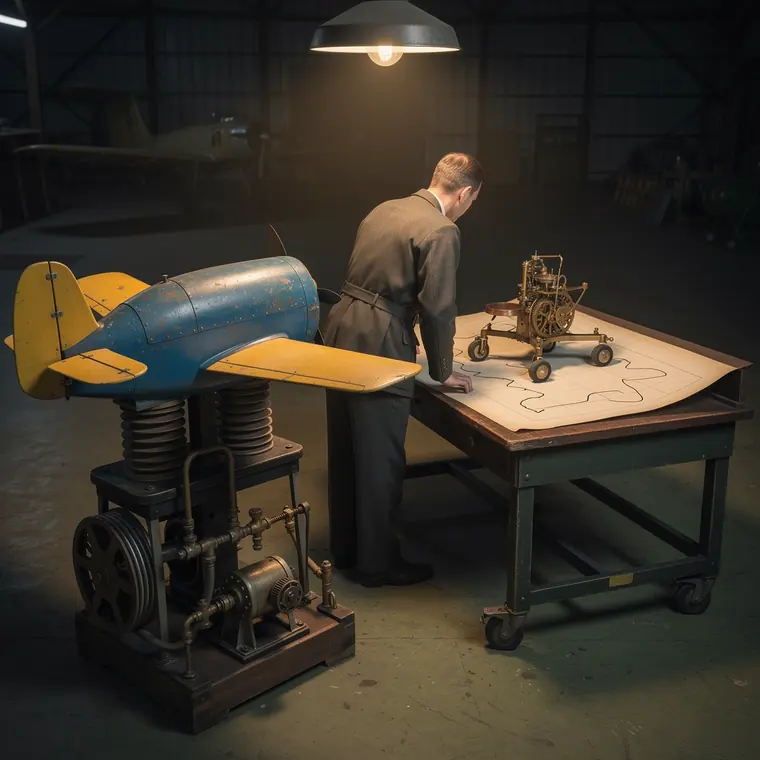
A small blue fuselage with stubby wings mounted on a bellows base, its hood closed, the fuselage blue with yellow wings and tail, the bellows beneath it partly inflated so the trainer sits tilted, an air pump and valves under the base, a wheeled plotting table beside it carrying a crab-like three-wheeled device that traces the flown course in ink on a plain chart, an anonymous instructor seen from behind at the table, in a flying school hangar, one hanging lamp lit above the trainer, the hangar beyond dark.
- What it was used for
- The Link Trainer was a flight training device on the ground: a short fuselage with a hood, mounted on pneumatic bellows, that answered control movements with bank, climb and dive. What was practised in it was flying by instruments and radio - the thing that decided life and death in bad weather or sudden loss of visibility. Edwin A. Link built it out of the technology of his family's piano and organ business; the ASME landmark brochure describes how the earliest trainer sat on organ bellows that inflated and deflated, drawing on the vacuum technology of the self-playing musical instruments of the 1920s. The later version converted the pilot's control movements through four bellows into turn, pitch and bank of the box.
- What was new
- What the device could do was answer back. The instruments in the box showed what the trainee had just done with the controls, so instrument flying could be practised without an aircraft and without risk. The ASME brochure dates the trainer to 1930 and keeps the kinds of date apart: an initial patent application of 14 April 1929 for the "pilot maker", the filing on 12 March 1930, and the grant on 29 September 1931. The barb is in the sales: on the Binghamton University Libraries exhibit, Link had difficulty selling the trainer to anyone other than amusement parks. Only after a demonstration in dark, rainy weather did the military order six trainers - in 1934, when mail pilots were crashing. Then it reversed: the ASME brochure says over 10,000 "blue box" trainers were used in the Second World War, that Link factories were turning out 80 a week at peak, and that over 500,000 pilots were taught to fly on them.
What the sources leave open: Neither source gives the price of the six trainers ordered in 1934. The ASME brochure gives no total production figure, only that over 10,000 trainers were in use during the war, which is not the same as built. Whether it was the first device of its kind the ASME brochure does not say; it only calls it "among the first mechanical devices used to simulate actual processes".
Connections
Every connection names its kind. “Forerunner” on its own would be a claim.
- Works withThe Crab1935The Crab sits on the instructor's desk and marks the flown route across a scaled map with an ink-coated tracer wheel. Its movement comes from the electro-mechanical wind drift computer in the base of the trainer, carried over by synchronous Telechron motors.Source: Military Aviation Museum, Link C-3 Flight Trainer - Restoration Update