Palmenhaus Schoenbrunn
1882 · Cast Iron Glasshouse Frame · Work 67 of 1,871
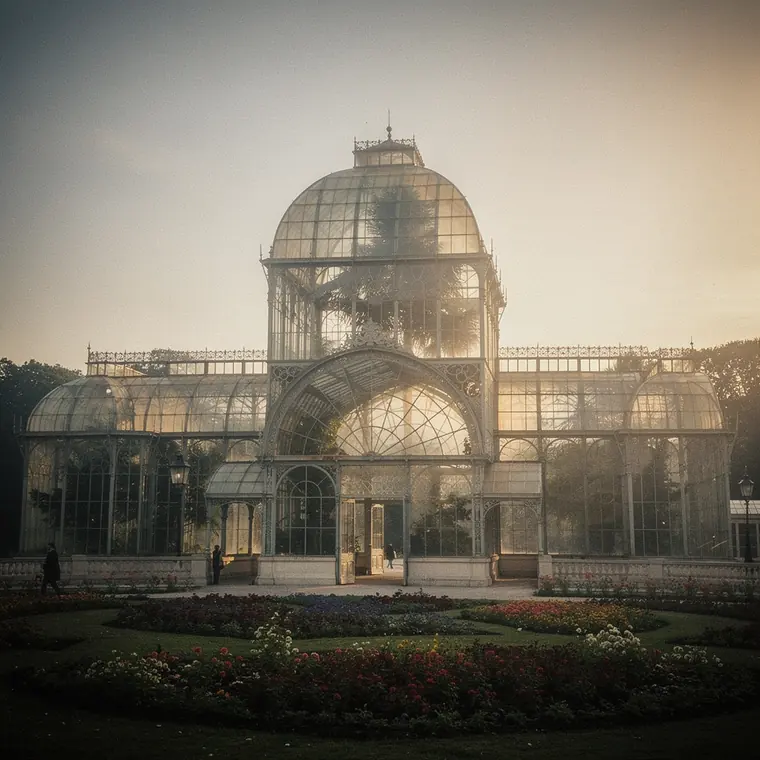
The Palmenhaus at Schoenbrunn, three glass pavilions linked by low passages with the tallest at the centre, cast iron members bolted into arching ribs above the imperial garden.
- What it was used for
- Imperial show house in the palace park, built from 1880 for Franz Joseph I to designs by the court architect Franz Xaver Segenschmid and opened on 17 June 1882. Three pavilions, three climates: at least 18 degrees in the southern hot house, 12 in the central temperate hall, 6 in the northern cold house. Heating came from three coal-fired boilers through an underground steam-and-water system, which is why the tropical house sits directly beside the boiler house. The building is 111 metres long, up to 28 metres wide, 25 metres at its highest point, and carries 45,000 panes over 4,900 square metres. The 600 tonnes of wrought iron came from Ignaz Gridl, the cast iron from R. Ph. Waagner.
- What was new
- The house was assembled from prefabricated parts and stood after two years; the iron frame lies outside, the glass clinging to the curved members like a skin. The operator calls it the largest glasshouse in the world at its opening - which does not hold: Kew's Temperate House had been in use since 1863, three-quarters complete at its opening by Kew's own account, and covers 4,880 square metres against Schoenbrunn's 2,500. How far the structure would carry was settled in February 1945: bombs fell nearby, the blast destroyed the glazing, part of the collection froze, and the house reopened only in 1953. The post-war glass lasted less than 25 years - closed in 1976, the frame entirely renewed from 1986 to 1990, and restored again from 2011 to 2014.
Connections
Every connection names its kind. “Forerunner” on its own would be a claim.
- Follows fromPalm House Kew1848The Austrian Bundesgaerten say it plainly: "Direktes Vorbild war das Palmenhaus in Kew Gardens." In 1878 court garden inspector Adolf Vetter and Franz Segenschmid travelled to London and saw the house of 1844-48; unlike Kew, Schoenbrunn got square corner pavilions on its wings.Source: Österreichische Bundesgärten, Grüne Schatzkammer: Ein Palast für exotische Pflanzen
Further reading
- Österreichische Bundesgärten: Das Große Palmenhaus (Maße, Scheiben, Klimazonen, 1945)
- Bundesgärten, Grüne Schatzkammer: Ein Palast für exotische Pflanzen (Kessel, Gridl, Waagner)
- Presse-Service der Stadt Wien: Palast der Blüten (600 t Schmiedeeisen, zwei Jahre Bauzeit)
- wien.ORF.at: Palmenhaus Schönbrunn (Wiedereröffnung 1953, 12.000 qm Glas)
- Wien Geschichte Wiki (Stadt Wien): Palmenhaus Schönbrunn (1976 gesperrt, 1990 wiedereröffnet)
- Waagner Biro: Palmenhaus (Neuaufbau des Tragwerks 1986-1990)