Schuchow-Turm Nischni Nowgorod
1896 · Hyperboloid Lattice Shell · Work 74 of 1,871
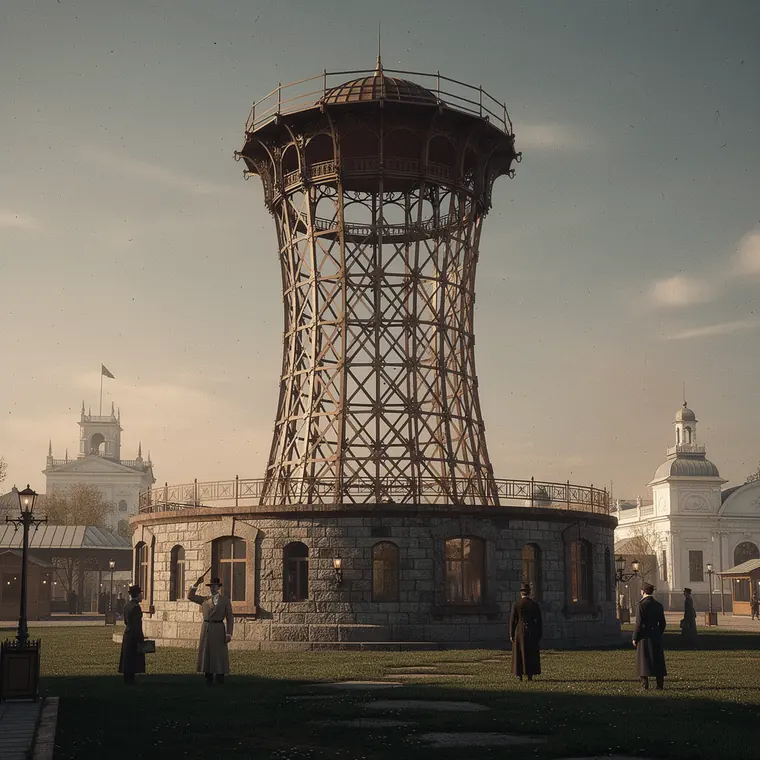
Shukhov's hyperboloid water tower at the Nizhny Novgorod exhibition of 1896, standing alone on open ground in the exhibition park with its whole base visible: a tall curved lattice of straight riveted steel bars, wide at the foot, narrowing to a waist and flaring again to carry a round water tank at the top, an access ladder climbing the framework, the tower standing on a circular stone foundation ring on level grass, exhibition pavilions and a few visitors in long coats and hats at a distance.
- What it was used for
- The tower was not a monument but the water supply of the Sixteenth All-Russia Industrial and Art Exhibition, which opened in Nizhny Novgorod on 28 May 1896; its tank, at the height of an eight-storey house, supplied the whole exhibition ground. It was built by the Bari firm to Vladimir Shukhov's design. After the exhibition the patron Yuri Nechayev-Maltsov bought it and had it moved to his estate at Polibino. There it went on working as a water tower until 1919, for the estate and for irrigating the orchard; a spiral stair of 150 steps leads to the viewing platforms. In 2024 the estate and tower were sold at auction with a starting price of 11.4 million roubles.
- What was new
- A curved surface made entirely of straight rods: two opposing sets of straight steel sections rest on one ring at the top and one at the bottom, and the result carries like a shell, needing - so the patent specification says - considerably less material than the usual method. A straight rod is cheap, easy to transport and can be joined without forge work; that, rather than the shape alone, is the difference from conventional lattice towers. The protection for it, Russian privilege no. 1896 for an "openwork tower" (azhurnaya bashnya), was filed on 11 January 1896 and granted only on 12 March 1899: three years after every visitor to the exhibition had been able to inspect the principle at full size.
Connections
Every connection names its kind. “Forerunner” on its own would be a claim.
- EncounteredPopov Storm Detector1895All-Russia Industrial and Art Exhibition, Nizhny Novgorod 1896: Shukhov built his first hyperboloid tower, a water tower, for this exhibition. At the same exhibition Aleksandr Popov installed his second lightning detector, a radio-wave receiver that recorded disturbances in the atmosphere.Source: Linda Hall Library, Scientist of the Day: Vladimir Shukhov · IEEE Spectrum: Who Invented Radio - Guglielmo Marconi or Aleksandr Popov?
Further reading
- Archiv der Russischen Akademie der Wissenschaften: Ausstellung zu Schuchow (Privilegien 1894-1896)
- Elementy.ru / Troizki Wariant Nr. 6 (374), 21.3.2023: Giperboloid Wladimira Schuchowa
- Zhivoe nasledie: Schuchow-Turm im Gut Polibino
- RIA Nowosti: Schuchow und der Turm von 1896
- Kommersant: Versteigerung des Guts Polibino 2024