Popov Storm Detector
1895 · Lightning Detector · Work 148 of 1,871
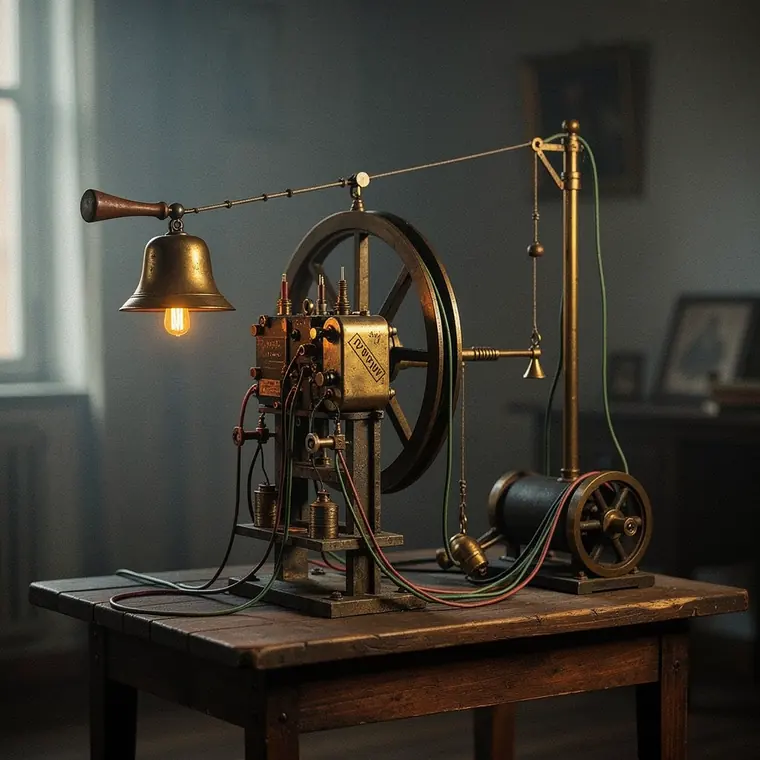
Popov's storm detector at the Saint Petersburg forestry institute, a coherer receiver whose relay rings a bell whose hammer taps the tube back, an aerial wire led up to a mast outside.
- What it was used for
- Aleksandr Popov taught at the Navy Torpedo School at Kronstadt. His apparatus put a coherer tube onto a sensitive relay, the relay onto a bell that also served as the tapper, and in parallel onto a recorder that drew a line on a paper band pulled by a twelve-hour clockwork. In his own words, as translated by Lodge, one electrode of the coherer was connected by an insulated wire to an ordinary lightning conductor and the other to earth, and the instrument registered by a cross line every electric wave that reached it from across the atmosphere. Set up in this way it stood at the Meteorological Observatory in St Petersburg from July 1895. The duty it performed was storm observation.
- What was new
- What was new was an unattended recorder that wrote down distant electrical discharges by itself, instead of leaving them to an observer. The demonstration to the Russian Physico-Chemical Society was on 7 May 1895, 25 April in the old style. The IEEE plaque speaks of signals sent and received over up to 64 metres; that is precisely what is disputed. Lodge, who in 1900 had Popov's paper in translation in front of him and denied any novelty in Marconi's early apparatus, writes that in 1895 Popov used the elevated wire as receiver, not as sender. The transmission of the words Heinrich Hertz on 24 March 1896 is undocumented: IEEE Spectrum states there is no official record, and the Linda Hall Library calls it unverifiable because the work was commissioned by the Navy. The barb: the secret naval work has vanished and the weather instrument is what survives. Popov died in 1906, two years before a commission of the Russian Physico-Chemical Society found in his favour.
Connections
Every connection names its kind. “Forerunner” on its own would be a claim.
- Follows fromBranly Coherer1890The heart of the instrument is Branly's tube. Popov, in Lodge's translation, writes of a sensitive relay in circuit with the coherer tube and of a bell that also serves as automatic tapper to reset the coherer; one electrode of the tube was joined to a lightning conductor, the other to earth. The IEEE milestone names as receiver a metal-filings coherer that Popov had developed himself.Source: Oliver J. Lodge, Signalling Across Space Without Wires, 3. Aufl., S. 60-62 (Popows Mitteilung von 1895 in Übersetzung nach The Electrician Bd. XL, S. 235) und S. 20 (Branlys Feilspänröhre) · IEEE Milestone (ETHW): Popov's Contribution to the Development of Wireless Communication, 1895 (Empfänger mit Metallfeilspäne-Coherer, Relais und Klingel)
- Follows fromHertz Spark Apparatus1887Popov excited the waves with Hertz's own sender. In his 1895 communication, as translated by Lodge, he writes that he detects waves at one kilometre if he employs as sender a Hertz vibrator with 30-centimetre spheres - the zinc spheres of the Karlsruhe dipole. The IEEE milestone: he had studied the works of Hertz and Lodge. New was the receiver, coherer and relay in place of the wire ring.Source: Oliver J. Lodge, Signalling Across Space Without Wires, 3. Aufl., S. 62 ('a Hertz vibrator with 30 centimetre spheres') · IEEE Milestone (ETHW): Popov's Contribution to the Development of Wireless Communication, 1895 ('He studied the works of Hertz, Lodge, and others')
- EncounteredSchuchow-Turm Nischni Nowgorod1896All-Russia Industrial and Art Exhibition, Nizhny Novgorod 1896: Popov installed his second lightning detector here. He had set up the first in July 1895 at the meteorological observatory of the Institute of Forestry in St Petersburg; it detected thunderstorms up to about 50 kilometres away. For the same exhibition Shukhov built his first hyperboloid tower, a water tower.Source: IEEE Spectrum: Who Invented Radio - Guglielmo Marconi or Aleksandr Popov? · Linda Hall Library, Scientist of the Day: Vladimir Shukhov
Further reading
- Oliver J. Lodge, Signalling Across Space Without Wires, 3. Aufl., S. 60-62 (Popows eigene Angaben, übersetzt nach The Electrician Bd. XL, S. 235)
- IEEE Milestone (ETHW): Popov's Contribution to the Development of Wireless Communication, 1895
- IEEE Spectrum: Who Invented Radio - Guglielmo Marconi or Aleksandr Popov?
- Linda Hall Library, Scientist of the Day: Alexander Popov
- Encyclopedia.com (Dictionary of Scientific Biography): Popov, Aleksandr Stepanovich (Kommission der Russischen Physikalisch-Chemischen Gesellschaft 1908)