The Bounty Chronometer
1771 · Marine Pocket Chronometer · Work 768 of 1,871
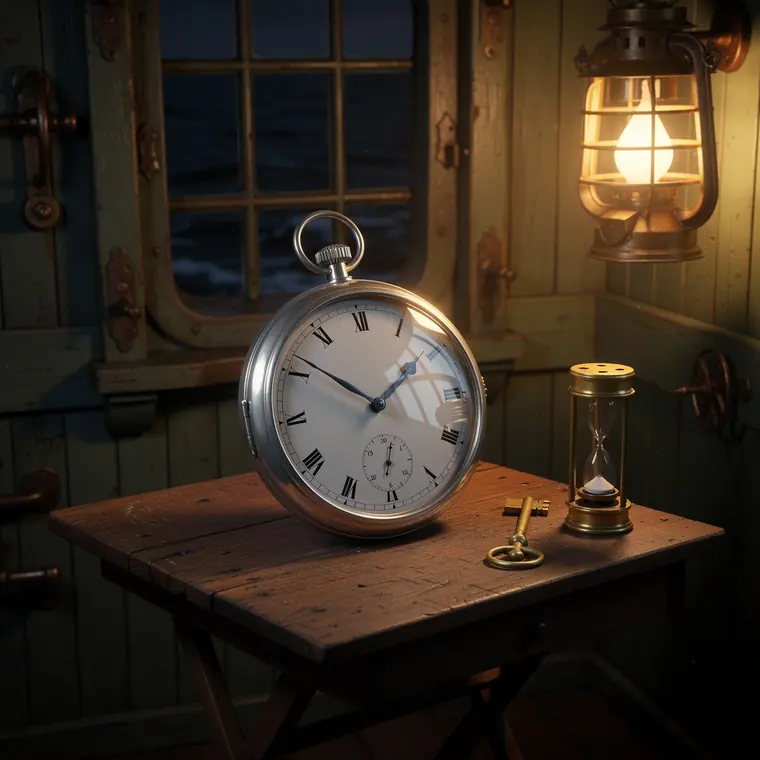
A large open-faced pocket watch of 1787 lying on a folding table in the panelled cabin of a small naval ship in the evening, the watch over sixteen centimetres tall with its bow, in a smooth bright silver case with a hinge lug at the left edge, a narrow bezel with a domed glass, its white enamel face turned at a slant away from the lens and soft in focus, one long blued steel hand and two small subsidiary discs below the centre, the lantern reflected in the glass, beside it a small brass winding key and a sandglass, a stern window with dark water beyond, warm lantern light from the right.
- What it was used for
- Larcum Kendall's timekeeper K2, dated 1771 on its back plate and handed to the Board of Longitude in March 1772, was the working instrument for finding longitude on board: a watch carrying the time of the port of departure. K2 was simplified compared with K1, had a regulator dial and wheelwork for the 3 separate hands with less play than the usual concentric arrangement. The collectors' site Antiquarian Horology gives 450 guineas for K1 and 200 guineas for K2 and records that K2 did not reach K1's precision. In 1787 K2 went to sea with William Bligh in the Bounty.
- What was new
- What was new about K2 was not the principle - K1 was a copy of Harrison's H4, and Kendall made no further copy after K1 - but the simplification: less work, less than half the price, less precision. The barb is the object's own route. After the mutiny Fletcher Christian took K2 to Pitcairn; in 1808 an American found it there and bought it from the last surviving mutineer. The watch reached England only in 1840, 69 years after the date on its back plate; today it is kept at Greenwich, as are K1 and K3.
Connections
Every connection names its kind. “Forerunner” on its own would be a claim.
- Follows fromHarrison H41761Kendall's K2 of 1771, the Bounty's timekeeper, employed many of the features of Harrison's H4. In 1769 the Board of Longitude had commissioned Kendall to make a simplified version, Harrison's design being too complex and expensive; Kendall omitted the remontoir, and it never performed well.Source: Royal Museums Greenwich, Collections: Marine timekeeper K3 (ZAA0111), with the history of K1 and K2 · Royal Museums Greenwich, Collections: Marine timekeeper K1 (ZAA0038), copy of H4 commissioned 1766