The Reflecting Circle
1790 · Full Circle Reflecting Instrument · Work 769 of 1,871
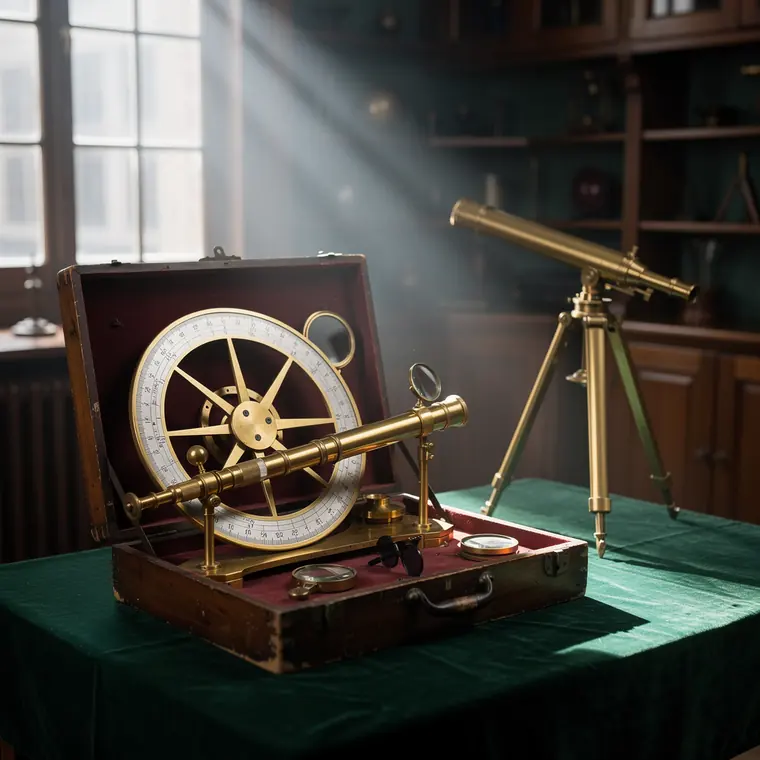
A reflecting circle of 1790 in its flat open mahogany case on a green cloth in the instrument cabinet of a college in New York, the instrument a full circle twenty-seven centimetres across, an outer rim of plain polished silver-coloured metal on a frame of golden brass with six radial spokes to a central hub, across the face a long brass bar carrying a brass telescope tube, a second shorter bar with a small mirror and shade glasses near the rim, each bar ending in a small magnifying glass, the case thirty-two centimetres square, beside it a brass telescope on a tripod, a tall window on the left, shelves soft behind.
- What it was used for
- The reflecting circle measured angles in the sky - altitudes and lunar distances - on the same double-reflection principle as the sextant, but on a full circle, so that the same measurement could be repeated around it and averaged. The example at the National Museum of American History is inscribed Lenoir A Paris no 10 and dated to the 1790s; the instrument is 26.67 cm across, its silvered scale graduated every 20 minutes and readable to single minutes through 2 verniers with tangent screws and magnifiers. It came into the collection from Columbia University.
- What was new
- The design is not by the man whose name is on the instrument: the museum points to the Chevalier de Borda, who published a description of his new reflecting circle in Paris in 1787, and names Lenoir as the maker of Borda's first instrument of this type. The full circle itself was not new with Borda: Tobias Mayer had already devised a reflecting circle in the 1750s because the octant often gave wrong results through faulty graduation; Borda's circle was an improved form of it. The measurement is repeated several times and the total angle divided by the number of repetitions. The piece is still catalogued as the Lenoir Reflecting Circle - after the maker, not the inventor.
Connections
Every connection names its kind. “Forerunner” on its own would be a claim.
- Follows fromThe Hadley Octant1731The reflecting circle rests on the same principle as the octant, angle measurement by double reflection as developed by Hadley in 1731, but has a full limb divided into 720 degrees. Tobias Mayer invented it in 1752 to improve on the octant, which often gave wrong results because of incorrect graduations. Textbooks around 1800 treated the circle and the sextant as derived from the octant.Source: Observatoire de Paris, An Etymological Dictionary of Astronomy and Astrophysics: reflecting circle · Museo Galileo, Catalogue: Octant and sextant - measuring angles by double reflection, Hadley 1731 · Danielle Fauque, Sur l'enseignement et la diffusion des instruments à réflexion à la fin du XVIIIe siècle, Cahiers François Viète 2 (2016), 37-59 (Zusammenfassung)