The Greenwich Time Ball
1833 · Visual Time Signal · Work 772 of 1,871
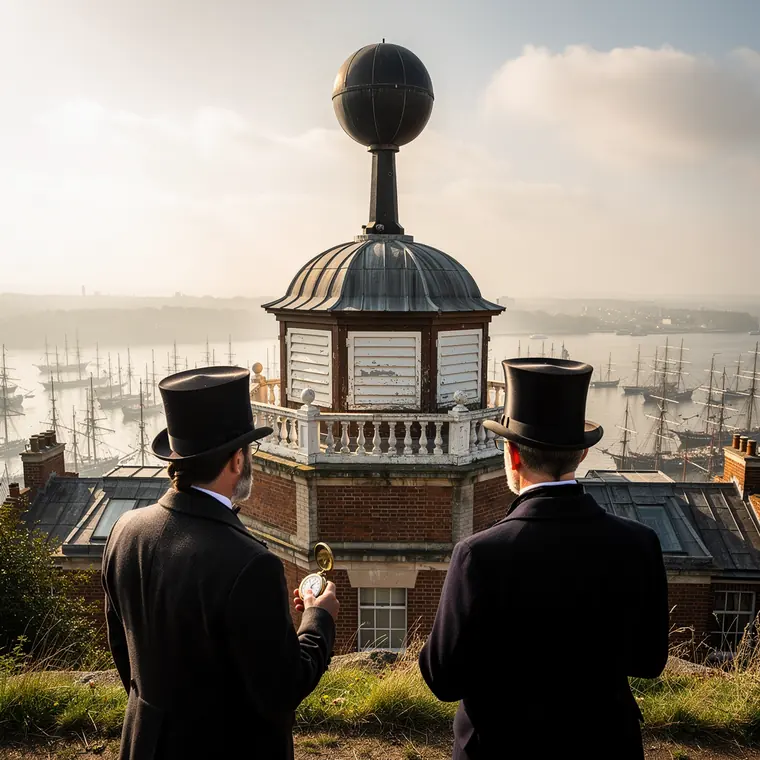
A time ball of 1833 on its mast above the east turret of the observatory at Greenwich, seen from the hilltop across the roof toward the river Thames, the turret an octagonal wooden lantern with white louvred panels under a flat leaden dome, a black wooden mast on the dome carrying a matt black leather ball one and a half metres across, below it a white balustrade and red brick walls, in the foreground two men in dark frock coats and tall hats seen from behind, one holding a pocket watch with its cover half open, below the grey river in haze crowded with ships' masts, midday sun from overhead.
- What it was used for
- A ball on a mast on the roof of Flamsteed House at the Royal Observatory Greenwich, set up in 1833 under the Astronomer Royal John Pond. It rose up the mast before the signal and dropped at exactly 1 pm. Navigators on ships in the River Thames and the London Docks set their chronometers by it before sailing. 1 pm rather than noon, because the astronomers were at the telescope observing the midday sun. The signal was purely visual, so it reached only as far as the mast could be seen.
- What was new
- Not the first time ball. Graham Dolan's history of the Observatory (royalobservatorygreenwich.org) dates the start to Portsmouth in 1829; Greenwich followed 4 years later. What was new was Greenwich now spreading the time itself: according to Dolan, Greenwich time had been used at sea since 1767 but was not widely disseminated from Greenwich until the 1830s. Distribution then moved from sight to wire - by 1853, according to the same source, the master clock also drove a clock at London Bridge station and sent daily galvanic signals along the main lines. The barb: the ball still drops after its purpose has gone; Greenwich Mean Time writes that it is now kept for the tourists.
Connections
Every connection names its kind. “Forerunner” on its own would be a claim.
- Works withThe Motor Clock1852From 1852 the ball's drop was released by an electric impulse from Shepherd's motor clock. The hourly signal relay added in 1861/62 was activated each hour by that clock; it was intended to relieve the ball-detent mechanism, whose mechanical mismanagement, according to Airy, had caused numerous errors in hourly signals.Source: Royal Museums Greenwich, Collections: Time ball (ZBA2245), Maudslay, Sons & Field, 1833 · Royal Museums Greenwich, Collections: Time signal relay (ZAA0718), Morris & Mapple, um 1861 · Royal Museums Greenwich, Collections: Electrical motor clock, Charles Shepherd, um 1852