The Echo Sounder
1913 · Acoustic Depth Sounding · Work 782 of 1,871
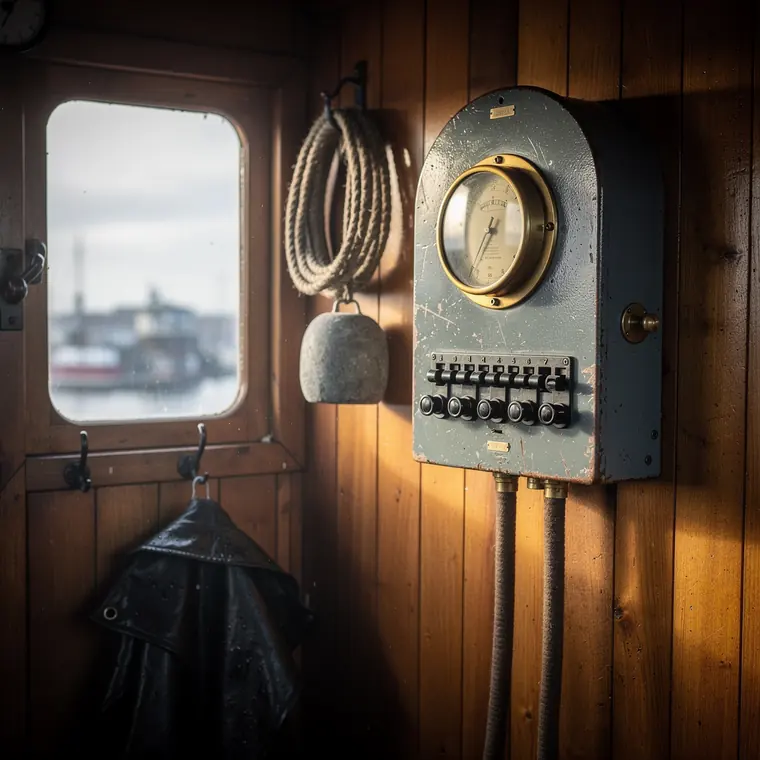
An echo sounding instrument of 1924 hanging on the wooden wall of a fishing steamer's wheelhouse in Kiel harbour, an upright rectangular sheet-metal case forty-five centimetres high, twenty-six wide and ten deep with a rounded top, matt grey-blue paint worn at the edges, in its upper part a round recessed face twelve centimetres across, seen at a steep slant, only a pale oval with one thin pointer, below it a row of small black knobs, two cloth-wrapped cables running down into the deck, by the window a coiled hand lead line with its grey lead weight, wet black oilskins on a hook, grey Baltic daylight from the left.
- What it was used for
- A method of measuring water depth with sound instead of sounding with wire. The GEOMAR brochure names Reichspatent No. 282009, which Alexander Behm, a physicist and businessman in Kiel, received on 22 July 1913: a first method for measuring the depth of the sea. What it replaced: a sounding machine at 4,000 metres needed about 30 minutes to reach the bottom and another 4 hours to be hauled up. At the end of 1915 Behm made his first sounding in Kiel Fjord, with a sonometer and a tuning fork; the navy ordered 4 echo sounders, which were not delivered because the war ended in 1918.
- What was new
- What was new was a depth measurement that did not hang on a wire - but in 1913 it was not yet usable. Vermessungsgeschichte.de calls the 1913 method impractical at first; Behm kept developing it, according to the GEOMAR brochure into the early 1930s and across more than 100 patents. The barb: the instrument did not come out of hydrography but out of a failed project. After the "Titanic" sank on 15 April 1912, Behm wanted to locate icebergs by sound; but icebergs reflected the sound irregularly, while the sea floor returned a clear echo. The iceberg warner turned into a sounder. The German Atlantic Expedition of 1925 to 1927 took 67,000 depth measurements with echo sounders.
What the sources leave open: The sources describe what Reichspatent No. 282009 claims only in general terms: GEOMAR calls it a „first method for measuring the depth of the sea“, vermessungsgeschichte.de a method based on sound and echo intensity. The brochure does not say which echo sounders the German Atlantic Expedition used.
Connections
Every connection names its kind. “Forerunner” on its own would be a claim.
- Follows fromTitanic1911After the Titanic sank in April 1912, Alexander Behm considered how obstacles such as icebergs might be located in time by reflected sound. His experiments showed the method unsuited to icebergs but good for measuring water depth. This led to his patent 282009, protected from 22 July 1913.Source: Deutsches Patent- und Markenamt, Postergalerie: Das Echolot (Patent 282009, Alexander Behm, Kiel 1913) · Werner Schneider: Alexander Behm und 100 Jahre Echolotpatente, Hydrographische Nachrichten 96 (Oktober 2013)