The Free Pendulum
1924 · Free Pendulum Master Clock · Work 783 of 1,871
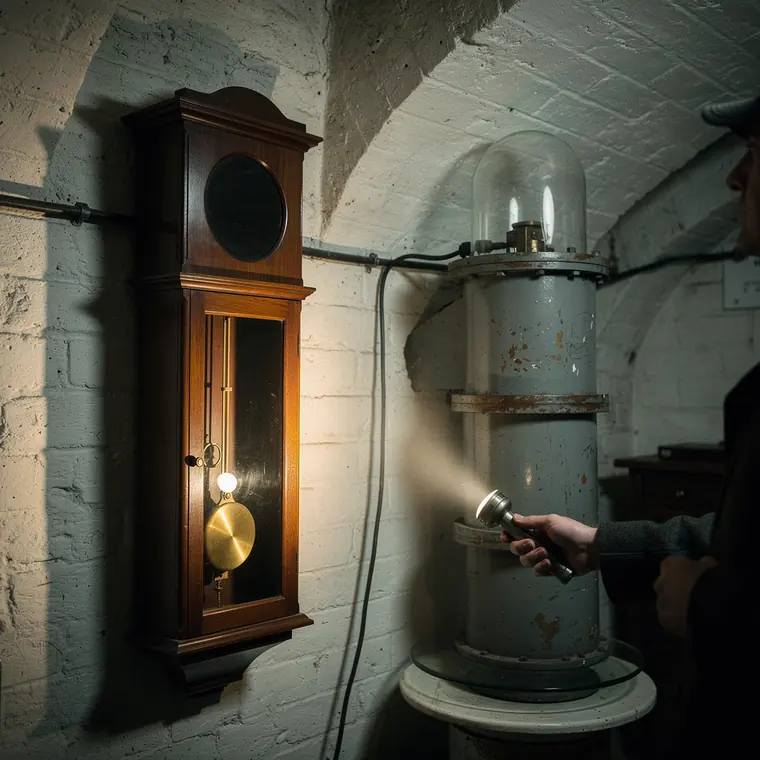
A free pendulum clock pair of 1924 in a vaulted whitewashed cellar under the observatory at Greenwich, in front a tall narrow slave clock in a dark mahogany wall case one hundred and sixty-five centimetres high, with a long glazed door over a swinging pendulum and a small round window above turned into shadow, behind at the edge an upright grey-painted copper cylinder one hundred and fifty centimetres tall with flange rings, a thick glass plate at its foot and a clear glass dome on top, a black cable along the wall between them, a hand in a dark woollen sleeve holding a torch, cold light from one bare lamp.
- What it was used for
- An observatory's standard clock. The pendulum hangs in a vacuum vessel so that air resistance, air pressure, temperature and humidity do not affect its rate; a slave clock takes over the escapement and, according to the Seiko Museum, gives the pendulum an impulse for 0.3 seconds every 30 seconds, leaving it free the rest of the time. At Greenwich, Shortt 3 arrived in the autumn of 1924, received on 21 November 1924, and became the sidereal standard on 1 January 1925; Shortt 16 arrived on 26 October 1927 and drove the rhythmic time signals from 19 December 1927. Royal Observatory Greenwich gives around 100 clocks produced, 8 of them at Greenwich.
- What was new
- Not the first free-pendulum clock. The text "Electrical Timekeeping" credits the first free pendulum to R. J. Rudd of Croydon, who patented a synchroniser in 1898, patent no. 19337, and notes that it was applied to a turret clock. What was new was the workable version: the Seiko Museum gives an error of only 1 to 2 milliseconds a day. The barb: the clock was so steady that the error was no longer in it. The NIST paper on the leap second credits free-pendulum clocks with revealing periodic nutation effects, notably an eighteen-year term of about 1 second amplitude, and reports that in 1937 Stoyko at the BIH, based on Shortt pendulum clocks and on comparing the rates of quartz clocks at national time services, found January's day length exceeding July's by 2 milliseconds. Then it fell in turn: pendulum transmitting clocks caused signal errors as large as 5 milliseconds, according to Royal Observatory Greenwich - in 1949 the GPO and BBC signals moved to quartz-controlled motors.
Connections
Every connection names its kind. “Forerunner” on its own would be a claim.
- Works withAiry Transit Circle1851Shortt no. 3, the first free-pendulum clock at Greenwich, was installed in November 1924; clocks of this type soon served there as sidereal and mean-time standards. Before 1927 the Observatory's time determinations were based on observations with the Airy transit circle: the transits of the clock stars gave the standard clock's error night by night.Source: Harold Spencer Jones: A brief history of the Time Department from 1923 to 1948 (Vortrag vom 27.1.1949), Royal Observatory Greenwich
Further reading
- The Shortt-Synchronome Free Pendulum Clock - The Seiko Museum Ginza
- Astronomical Regulators: Shortt free-pendulum clocks Nos 3, 11, 16, 40, 49, 61, 66 & 67 - The Royal Observatory, Greenwich
- The leap second: its history and possible future (Metrologia), NIST Time and Frequency Division
- Electrical Timekeeping (Scan) - clockdoc.org