Airy Transit Circle
1851 · Meridian Circle · Work 204 of 1,871
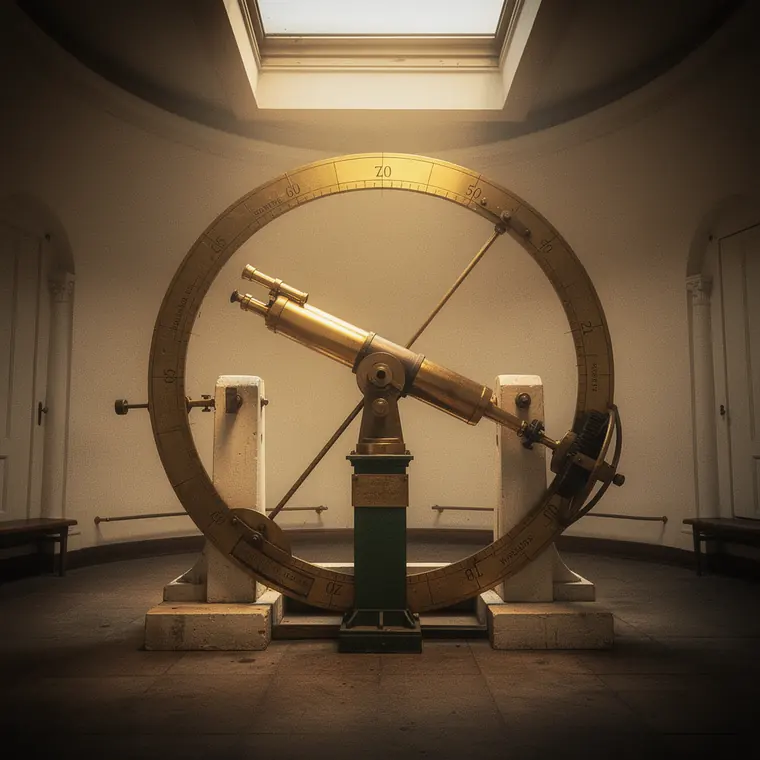
The Airy transit circle at the Royal Observatory Greenwich, short telescope pivoting between two graduated circles on stone piers, slit in the meridian room roof standing open.
- What it was used for
- With this meridian instrument, astronomers at the Royal Observatory, Greenwich, timed the moment stars crossed the meridian. That gave star positions and the time: known clock stars were used to set the observatory's clocks, and with them Greenwich Mean Time. The first observation was made on 4 January 1851; the instrument was in continual use until 1938, and the last observation came in 1954. In total it made more than 600,000 observations. In 1884 a conference in Washington recommended that the prime meridian of the world pass through this instrument. Yet anyone standing on the line with satellite navigation today does not see 0°: zero lies about 102 metres further east (Malys et al., Journal of Geodesy 2015). The reason is the plumb line the instrument was aligned to, which local gravity deflects slightly.
- What was new
- Airy's instrument measured both coordinates of a star, right ascension and declination, in a single observation. At Greenwich that had previously taken two separate instruments: Troughton's 10-foot transit instrument and the mural circles. This was new only for Greenwich. On the Continent, meridian circles by Reichenbach and Repsold had replaced separate instruments from 1818–19, for example at Göttingen and Königsberg. Airy deliberately built it differently: a single divided circle, massive piers, no regard for symmetry, and a telescope that could not be reversed. The 1911 Encyclopædia Britannica singles out exactly this departure from all other instruments. With the new position, the Greenwich meridian moved almost six metres east in 1851, away from the line of the earlier Astronomer Royal James Bradley.
Connections
Every connection names its kind. “Forerunner” on its own would be a claim.
- Works withThe Motor Clock1852Two parts of one time service. Royal Museums Greenwich on the meridian instrument: "observations of stars with the transit circle were used to set Greenwich Mean Time". From 1852 the Shepherd master clock passed that time on; by Airy's report of 1853 it kept the gate clock, the chronometer-room clock, two other observatory clocks and one at London Bridge terminus in step.Source: Royal Museums Greenwich: Airy's Transit Circle and the dawn of the Universal Day · Royal Museums Greenwich, Sammlung: Electrical motor clock (Airys Bericht von 1853; 'the heart of Britain's time system') · Edwin Dunkin: The Royal Observatory, Greenwich (1891), wiedergegeben auf royalobservatorygreenwich.org (Graham Dolan)
- Works withThe Greenwich Time Ball1833The circle determined the time, the ball gave it out. Royal Museums Greenwich: "observations of stars with the transit circle were used to set Greenwich Mean Time"; the ball falls "at 13.00 exactly". Between them stood the Shepherd master clock; Airy wrote of it in 1853: "It drops the Greenwich Ball".Source: Royal Museums Greenwich: Airy's Transit Circle and the dawn of the Universal Day · Royal Museums Greenwich: The Greenwich Time Ball and one time for all · Royal Museums Greenwich, Sammlung: Electrical motor clock (Airys Bericht von 1853: 'It drops the Greenwich Ball')
Further reading
- Royal Museums Greenwich: Airy's Transit Circle and the dawn of the Universal Day
- Royal Museums Greenwich: Airy Transit Circle telescope
- Telescope: Airy's Transit Circle (1850) – royalobservatorygreenwich.org
- Description of the Airy Transit Circle from the introduction to the 1908 volume of Greenwich Observations
- The Greenwich Meridian before the Airy Transit Circle – thegreenwichmeridian.org
- Malys, S. et al.: Why the Greenwich meridian moved. Journal of Geodesy 89 (2015), 1263 (Abstract, ADS)
- Encyclopædia Britannica 1911, Artikel „Transit Circle“ (Wikisource-Transkription)