The Handheld Receiver
1989 · Handheld Satellite Positioning · Work 799 of 1,871
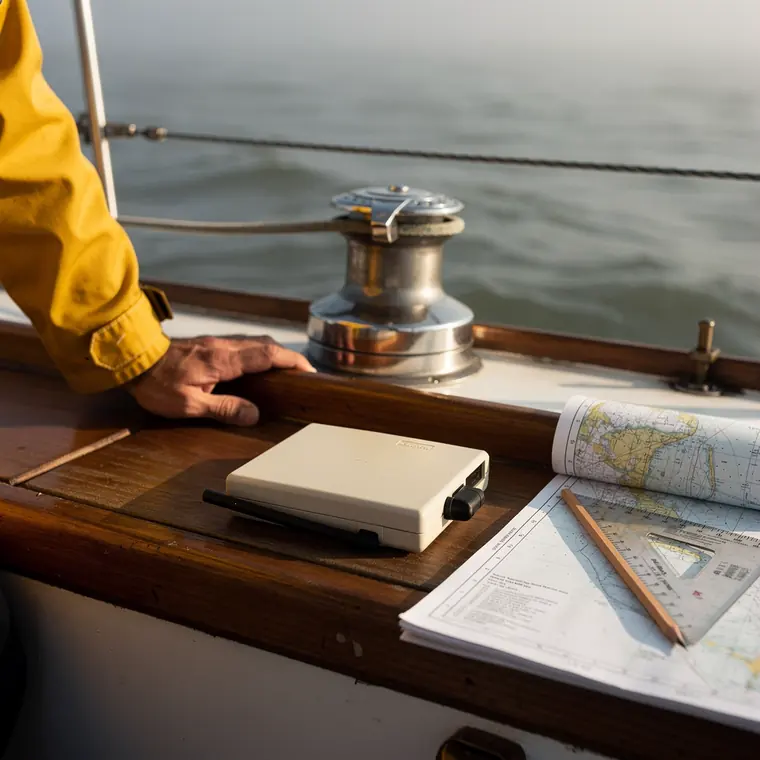
A handheld satellite navigation receiver of 1989 on the teak cockpit seat of a sailing yacht off California in the morning, a flat device twenty-two centimetres long in a cream-white plastic housing with rounded edges, lying face down on the teak so that only its plain cream back and rounded edges show, a short dark aerial folded along its side, beside it a sea chart at a flat angle seen from the side along the seat, a course triangle and a pencil, a hand in a yellow oilskin sleeve resting on the coaming, a chrome winch, wire lifelines, grey-blue water, low sun from the left.
- What it was used for
- The Magellan NAV 1000, the first product of the Magellan Systems Corporation, founded in 1986 by Ed Tuck. The Smithsonian finding aid to the company's records states that the device shipped in May 1989, measured 8.75 x 3.5 x 2.25 inches, weighed 1.5 pounds and sold for approximately $3,000. According to the National Air and Space Museum's object description it received the satellites one after another rather than simultaneously; it stored 100 waypoints, allowed one active route, switched itself on for a fix by means of an alarm function and, after the first fix, updated the position every few seconds. In the same year, according to the finding aid, the firm also entered the military market with the NAV 1000M.
- What was new
- What was new was a hand-held GPS receiver that could be bought commercially; the museum calls the NAV 1000 the first such device. The barb is in the same museum description: at the 1989 launch the full constellation of 24 operational GPS satellites was not yet in orbit, and for that reason the device carried a planning function with which one could check in advance whether a 2-dimensional or 3-dimensional fix was possible at all at a given place and time. A navigation device whose first job was to say when it could do nothing.
What the sources leave open: The sources do not say exactly who bought the NAV 1000; the finding aid lists customer letters of 1989-1993 from Magellan users, mostly maritime, and market research for marine, outdoor and hunting markets. It calls the NAV 1000 the first handheld commercial receiver, but elsewhere the NAV 1000 PRO (1990) the world's first hand-held GPS product. Size: museum 22.2 x 11.7 x 5.1 cm (8 3/4 x 4 5/8 x 2 in.), finding aid 8.75 x 3.5 x 2.25 in.
Connections
Every connection names its kind. “Forerunner” on its own would be a claim.
- Follows fromThe Transit Satellite1960The GPS whose signals this handheld set reads demonstrably took two things from Transit: the dual-frequency ionospheric correction developed for Transit, which was incorporated into GPS to attain the highest positioning accuracy, and orbit prediction handled with modifications to the Transit-developed orbit-prediction programs called Celeste.Source: The Origins of GPS, and the Pioneers Who Launched the System, GPS World (Teil 1) · V. L. Pisacane, The Legacy of Transit, Johns Hopkins APL Technical Digest 19 (1998)