Anderton Boat Lift
1875 · Hydraulic Iron Boat Lift · Work 80 of 1,871
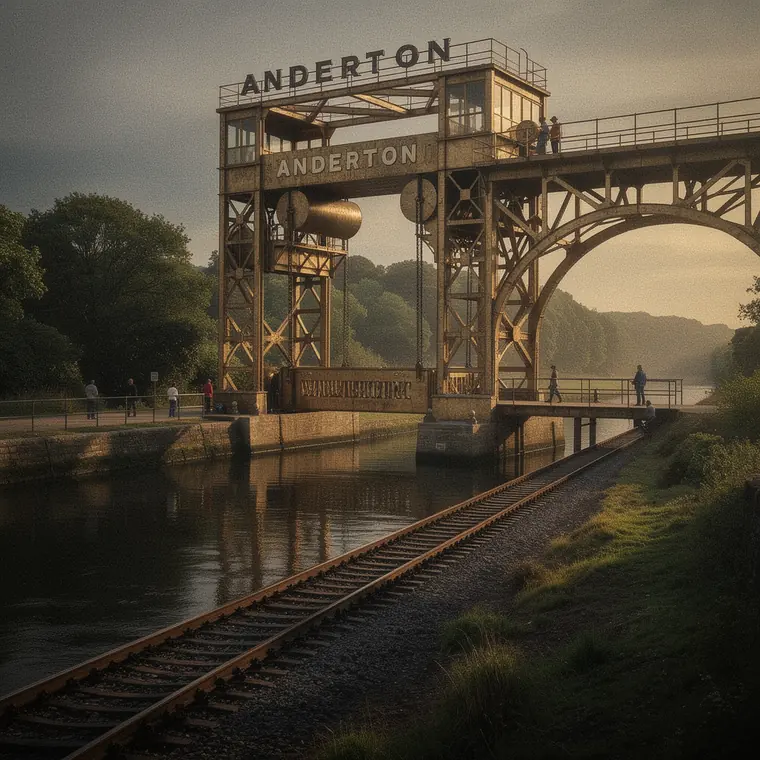
The Anderton Boat Lift beside the river Weaver, two iron caissons of water held in a tall braced frame, hydraulic rams below and an aqueduct arm reaching to the canal.
- What it was used for
- The lift connected the Trent and Mersey Canal with the River Weaver 15.24 metres below, and opened on 26 July 1875. It raised barges of up to 100 tons: salt from the Cheshire field down to the river, pottery and clay up. Two caissons each stood on a single cast-iron ram three feet in diameter, water and barge together some 240 tons; the caissons were coupled so that the descending one raised the other. Between 1906 and 1908 it was converted to electric operation, with only 49 days out of service across two years. In 1983 it was closed because of corrosion - Historic England says 1984 - and reopened in 2002 after more than seven million pounds. Around 3,000 boats use it each year.
- What was new
- Boat lifts existed before: James Green built seven on the Grand Western Canal, in traffic from 1838, but for tub boats carrying eight tons, and their machinery was removed after closure in 1867. The difference is scale and durability, not priority: Anderton moved whole barges together with their water, instead of a flight of locks that wastes water from the pound at every cycle. The hydraulic fluid was canal water - and in the salt district that water was saline. Grooves appeared in the rams as early as 1882, and by 1908 the hydraulics were gone. When they came back in 2002 they ran on oil; the electric structure of 1908 remains standing as a monument that no longer does anything.
Connections
Every connection names its kind. “Forerunner” on its own would be a claim.
- Follows fromBritannia Bridge1850Edwin Clark was resident engineer of the Britannia Bridge, where the tubes were raised by hydraulic presses. His obituary at the Institution of Civil Engineers records that the idea of lifting vessels bodily out of the water by hydraulic power came to him from those very presses; the sentence is about his lift graving dock of 1857. At Anderton each caisson stands on one iron ram.Source: Grace's Guide: Edwin Clark, Wortlaut des ICE-Nachrufs 1895 ('by the same means which had been adopted in raising the huge tubes of the great bridges, namely, hydraulic-power') · Linda Hall Library, Scientist of the Day: Edwin Clark (Hebung der Röhren für Robert Stephenson; später der Bootslift) · Historic England, Scheduled Monument 1021152: Anderton Boat Lift (hydraulischer Lift nach Entwurf von Edwin Clark, eröffnet 1875; zwei gegengewichtige Tröge, jeder auf einem zentralen eisernen Presskolben)
Further reading
- Historic England, Scheduled Monument 1021152 (Anderton Boat Lift)
- Canal & River Trust: Anderton Boat Lift, 150th anniversary
- Canal & River Trust: Engineering the Future, FAQ (Salzwasser, 3.000 Boote)
- Elevator World: The Anderton Canal Lift, 1875-1908 (Kolben, Lasten, Riefen 1882)
- IStructE, The Structural Engineer 81/20 (2003): The restoration of the Anderton Boat Lift
- National Transport Trust: Anderton Boat Lift (Umbau 1906-08, 49 Tage)