McNaught Beam Engine
1845 · Beam Engine · Work 88 of 1,871
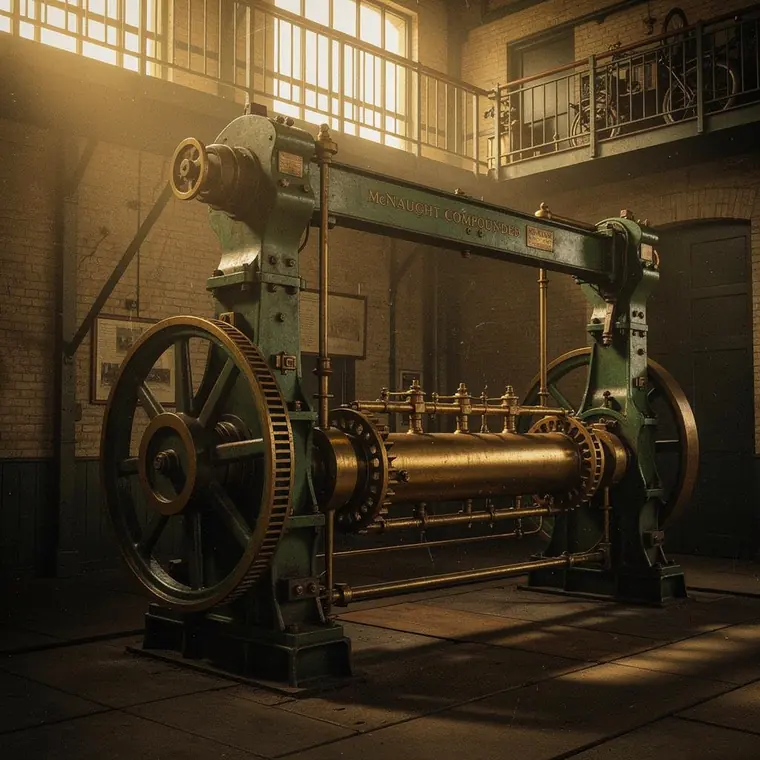
A McNaught compounded beam engine, added high pressure cylinder driving the beam between centre and end, engine house galleries on two levels around it.
- What it was used for
- The method was aimed at engines already running. Textile mills had older beam engines that had grown too weak for the number of looms. McNaught put a small high-pressure cylinder between the beam end and the beam centre, on the other side of the pivot from the old low-pressure cylinder; the steam worked there first and then again in the old cylinder. The Smithsonian records that hundreds of engines had their capacity increased this way, and that new engines were built on the principle for many years afterwards.
- What was new
- No thermodynamic idea was new here. Compounding came from Woolf. What was new was that it could be fitted to an engine already at work, instead of replacing it. The 1845 specification, patent no. 11001, names exactly that purpose: "the effect of increasing the power of the engine, of lessening the consumption of fuel in proportion to the power produced". Placing the cylinders on either side of the pivot had the further advantage that the forces partly cancelled at the beam centre. How many engines were converted cannot be established; beyond "hundreds" there is no figure. The percentages for added power and coal saving that are often quoted could not be traced to any solid source and are therefore left out.
Connections
Every connection names its kind. “Forerunner” on its own would be a claim.
- Follows fromWoolf Compound Engine1804The added high-pressure cylinder turned the old beam engine into a compound. The obituary in The Engineer (1881) says the conversion made the engine "one of the compound principle" and was easier on the main centre bearings than the arrangements built under Woolf's patent.Source: The Engineer, 21. Januar 1881, Nachruf William McNaught (Transkription bei Grace's Guide) · Smithsonian NMAH: Model of McNaught Type Compound Steam Engine ('the addition of compounding to standard beam engines')