Woolf Compound Engine
1804 · Compound Engine · Work 87 of 1,871
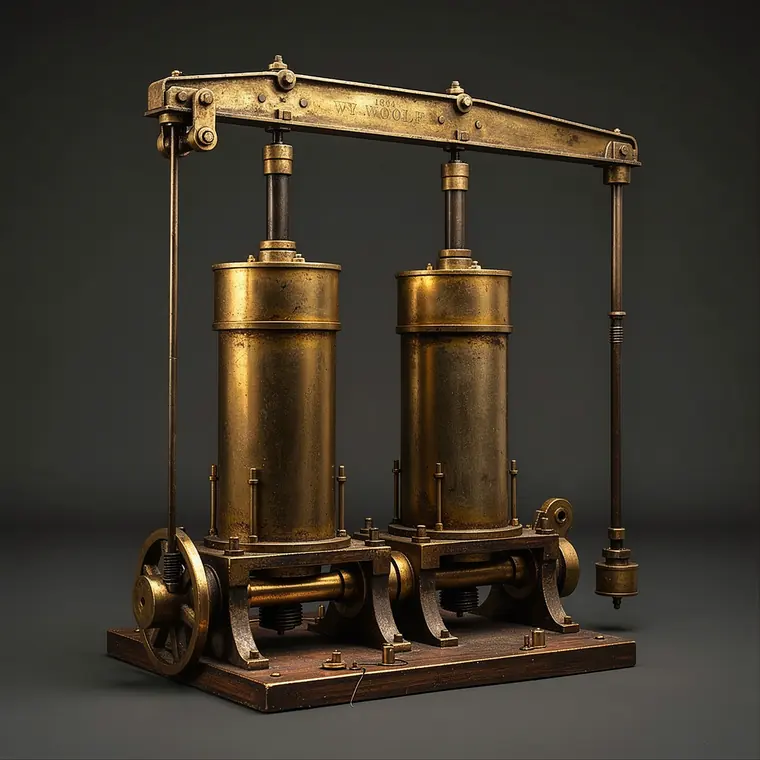
A Woolf compound beam engine: two vertical cylinders standing side by side upright on the engine-house floor, a small-bore high pressure cylinder and a much larger low pressure condensing cylinder, both closed at the top, both piston rods rising to the SAME end of one great overhead rocking beam pivoted on a masonry wall, the far end of the beam working a pump rod downward, the difference in bore clearly visible between the two cylinders.
- What it was used for
- Arthur Woolf was resident engineer at Meux's brewery in London from April 1797 to October 1806. His compound principle, steam working first in a small high-pressure cylinder and then again in a larger one, later went into the pumping engines of the Cornish mines, where Woolf worked for Harvey & Co of Hayle; through his partner Humphrey Edwards the type went to France, where Woolf engines and boilers were built in numbers. In Cornwall economy was measured as "duty", in millions of foot-pounds per bushel of coal. In October 1814 a Woolf engine at Wheal Abraham reached 34 millions against a Cornish average of 20.5; in December 1827 one of his 90-inch engines did 63.5 millions.
- What was new
- Two-cylinder expansion was not itself new. Jonathan Hornblower had patented such an engine in 1781, got nowhere with it at Watt's low pressures, and was stopped in court by Boulton & Watt. Woolf's arrangement worked because it married the compound principle to high boiler pressure: only a large pressure drop makes splitting the expansion between two cylinders worth the trouble. The patent year is given variously as 1804 and 1805. The barb: at first the sums did not add up. By the mid-1820s experience had shown the compound engine to be less economical than the single-cylinder high-pressure engine of Cornish type. Only later, with higher boiler pressures and above all at sea, did the principle prevail.
Connections
Every connection names its kind. “Forerunner” on its own would be a claim.
- Follows fromHornblower Compound1781About 1797 Woolf helped Hornblower out of a difficulty with his two-cylinder engine at Meux's London brewery and was then made resident engineer there. His patent of 1804, in the words of an 1874 tribute, applied high-pressure steam and Watt's condenser to Hornblower's two-cylinder engine.Source: Grace's Guide: Arthur Woolf (Meux's Brewery; 'In 1804 he patented his mode of working high-pressure steam, and Watt's condenser to Hornblower's two-cylinder engine') · Encyclopaedia Britannica: Arthur Woolf ('revived and improved Jonathan Hornblower's compound engine of 1781')
- Follows fromWatt Separate Condenser1769Woolf's compound engine condenses in a separate vessel. An 1874 tribute puts his patent in a single line: he applied high-pressure steam and Watt's condenser to Hornblower's two-cylinder engine. The DNB calls his improvements a revival of Hornblower's compound engine, made possible by the expiry of Watt's patent.Source: Grace's Guide: Arthur Woolf, Würdigung von 1874 ('In 1804 he patented his mode of working high-pressure steam, and Watt's condenser to Hornblower's two-cylinder engine') · Dictionary of National Biography 1885-1900: Woolf, Arthur (Wikisource; Patente 1804/1805 Nr. 2772, 2863; Wiederbelebung von Hornblowers Verbundmaschine nach Auslaufen von Watts Patent; Rückkehr nach Cornwall 1812)
Further reading
- Grace's Guide: Arthur Woolf (Meux 1797-1806, Duty-Zahlen Wheal Abraham 1814 und 1827, Edwards in Frankreich; nennt 1805 als Patentjahr)
- Selgin/Turner, Strong Steam, Weak Patents (Patentjahr 1804; Verbundmaschine bis Mitte der 1820er unwirtschaftlicher; Opposition gegen Hornblower 1792)
- Nuvolari/Verspagen, Diffusing New Technology Without Dissipating Rents (cornische Duty-Messung, Lean's Engine Reporter)