Corliss Valve Gear
1849 · Precision Valve Gear · Work 89 of 1,871
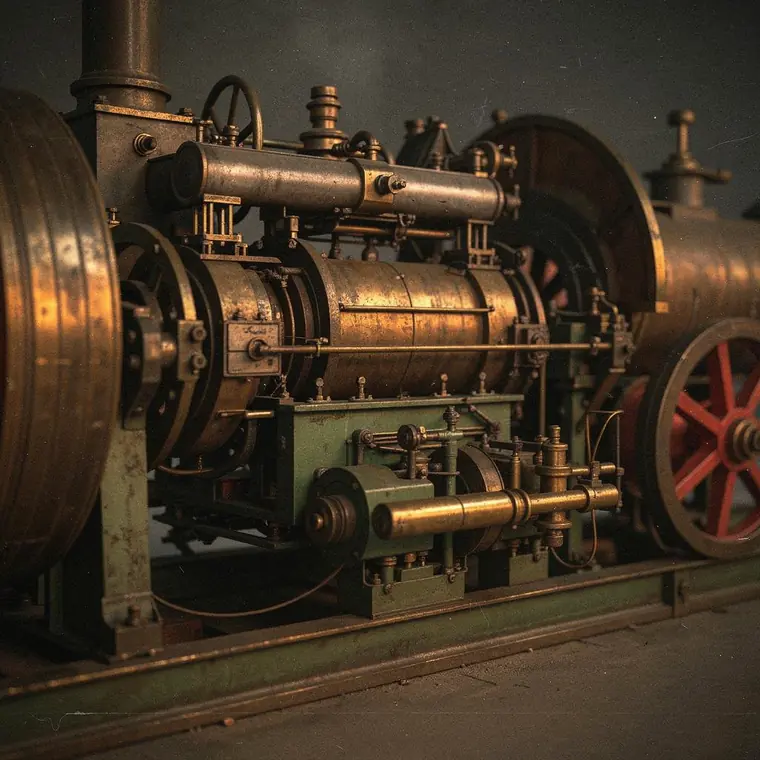
The wrist plate and rocking valve gear of a Corliss engine in close view, four rotary valves around the cylinder, trip mechanism and dashpots below.
- What it was used for
- The gear drove above all the spinning and weaving mills of New England, later blowing and pumping engines too. Its most famous example stood in 1876 in Machinery Hall at the Philadelphia Centennial: 1,400 horsepower at 36 rpm, 44-inch bore, 10-foot stroke, a flywheel 30 feet across weighing 56 tons. Through more than a mile of shafting it supplied 13 acres of exhibited machinery; President Grant and Emperor Dom Pedro II started it. The Pullman museum gives different figures for the same engine, 2,500 horsepower and a 40-inch bore.
- What was new
- Cutting off steam early was not new; Frederick Sickels had patented a workable drop cut-off in 1842 which ran on side-wheel steamboats into the 20th century. What was new was that the governor reset the cut-off point stroke by stroke, through four separate valves whose admission valves are released by a trip. Patent no. 6162, 10 March 1849; the cylindrical rotary valves came only in the early 1850s and were never patented. ASME puts the effect at about 30 percent less fuel and much closer speed regulation, which in a spinning mill decides whether threads break. The barb: Corliss is said to have spent over $100,000 on patent litigation, as much as the exhibition engine cost to build; his company went down in 1893, and the 1876 engine ran at Pullman in Chicago until electricity displaced steam and it was scrapped. The year is disputed: 1905 and 1910 are both given.
Connections
Every connection names its kind. “Forerunner” on its own would be a claim.
- Follows fromCentrifugal Governor1788Corliss hung the point of cut-off on the flyball governor: if the engine runs fast, the governor trips the inlet valves shut earlier. The Smithsonian calls patent 6162 of 10 March 1849 the first variable cut-off valve gear in which the point of cut-off is determined by the engine governor.Source: Smithsonian NMAH: Corliss's Patent Model of a Steam Engine, ca 1849 (Patent 6162, 10.03.1849) · Smithsonian Institution: Corliss's Patent Model of a Steam Engine, ca 1849 (Objektbeschreibung)
Further reading
- ASME Landmark, New England Wireless and Steam Museum (Patent Nr. 6162 vom 10.3.1849, rund 30 Prozent Brennstoff, Drehzahlhaltung, Textilmaschinen)
- New England Wireless and Steam Museum: Corliss Centennial Engine (1400 PS, 36 U/min, 44 Zoll, Schwungrad, Machinery Hall, Betrieb bei Pullman bis 1910)
- Pullman State Historic Site / Pullman Museum: The Corliss Engine (2500 PS, 40 Zoll, 77 000 Dollar, verschrottet Herbst 1910)
- Rhode Island Heritage Hall of Fame: George H. Corliss (über 100 000 Dollar Prozesskosten, Verschrottung 1905 für 7892,50 Dollar, Firmenzusammenbruch 1893)
- Smithsonian NMAH: Sickels Drop Cut-Off Valve Gear, Patentmodell (Patent Nr. 2631 vom 20. Mai 1842)