Tandem Compound Engine
1880 · Cylinders in Series · Work 95 of 1,871
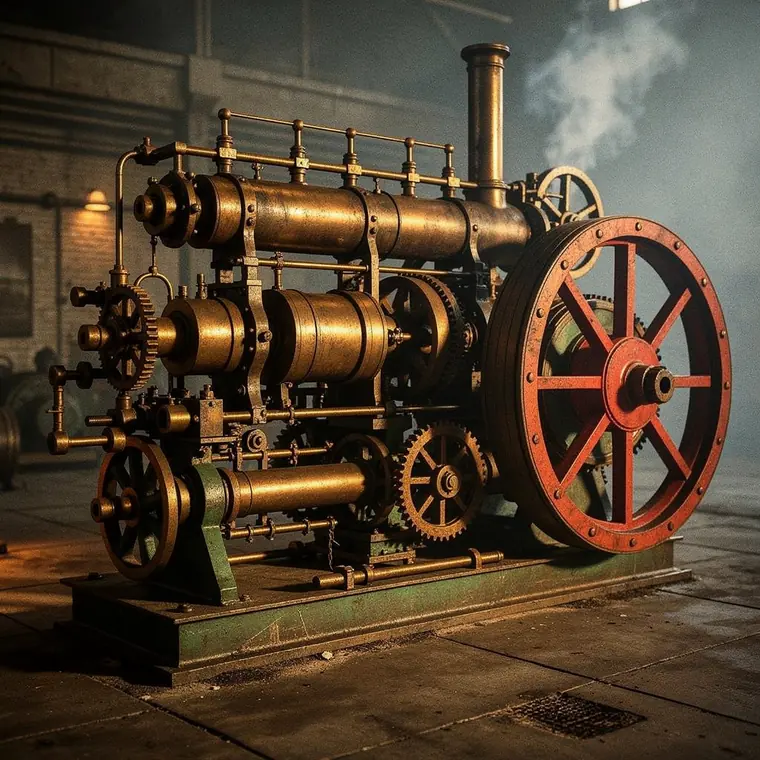
A tandem compound mill engine, high and low pressure cylinders in line on a single piston rod, massive flywheel with rope grooves at the far end.
- What it was used for
- High- and low-pressure cylinders sit one behind the other on a single piston rod, driving one crank. This was one of the usual forms of the mill engine. At Queen Street Mill in Briercliffe one still stands: "Peace", built by William Roberts of Nelson, remodelled by the same firm in 1914, rated 500 hp, cylinders of 16 and 32 inches, 4-foot stroke, 14-foot flywheel; it drove the weaving shed, where 308 Lancashire looms remain today. The build year is disputed: Historic England gives 1895, the Lancashire county museum service 1894. Textiles were not the only field. The MAN Nuremberg type LT 10 tandem engine of 1907, close to 1500 hp, flywheel of 5 m and nearly 30 tons, first worked two decades at Opel in Ruesselsheim, from 1927 in a Thuringian paper mill and from 1938 in the Julius Tafel iron rolling mill in Nuremberg.
- What was new
- The compound principle was old by 1880; Hornblower and Woolf had it decades earlier. What was new was the pressure, and new because of the steel boiler. Daniel Adamson, whose firm per the obituaries supplied over 2,800 to 3,000 steel boilers for 50 to 250 lb, and whose 110 lb plant of 1873 was regarded as a novel and even doubtful departure, told the Iron and Steel Institute in 1875 that 150 lb could be carried with less risk than the usual 50 lb. What the tandem arrangement could do: put the output of two cylinders on a single crankpin, in a single-cylinder engine's space, except in length. What it could not do: run fast, since everything bears on one set of journals, and the steam passage between cylinders is long. The quoted saving rests half on an assumption: Thurston reports 1.62 lb of coal per horsepower-hour for the Corliss engine at the Nourse mill, but for the same engine without its high-pressure cylinder merely supposes it "would probably not require less than two pounds".
Connections
Every connection names its kind. “Forerunner” on its own would be a claim.
- Follows fromWoolf Compound Engine1804The 1874 paper on compound engines in the Proceedings says it plainly: there is nothing new in the compound engine, its essential feature borrowed from the precedents of Hornblower and of Woolf, 1781 and 1804. It only began to pay at high boiler pressure, sixty pounds per square inch in the engines discussed there.Source: U.S. Naval Institute Proceedings, Dezember 1874: Compound Engines ('borrowed from the precedents of Hornblower and of Woolf ... 1781 and 1804') · Encyclopaedia Britannica, 9. Aufl., Art. Steam Engine, Abschnitt Compound Expansion (1902encyclopedia.com; 'Woolf engine' = Verbund ohne Zwischenbehälter, 'engines of the tandem type satisfy this condition')
Further reading
- Historic England, Listing 1416482: Queen Street Mill, Briercliffe
- Lancashire County Museum Service: Queen Street Mill steam engine
- Museum Industriekultur Nürnberg: MAN Tandem-Dampfmaschine Typ LT 10 (1907)
- R. H. Thurston, A Manual of the Steam-Engine, Part I, 6. Aufl., Wiley 1903
- Grace's Guide: Daniel Adamson (Nachrufe IMechE 1890, The Engineer 17.01.1890)
- Grace's Guide: Arthur Woolf (Verbundmaschine, Patent 1804/1805; Hornblowers Zweizylindermaschine)