Splicing Chamber
1866 · Cable Splice · Work 137 of 1,871
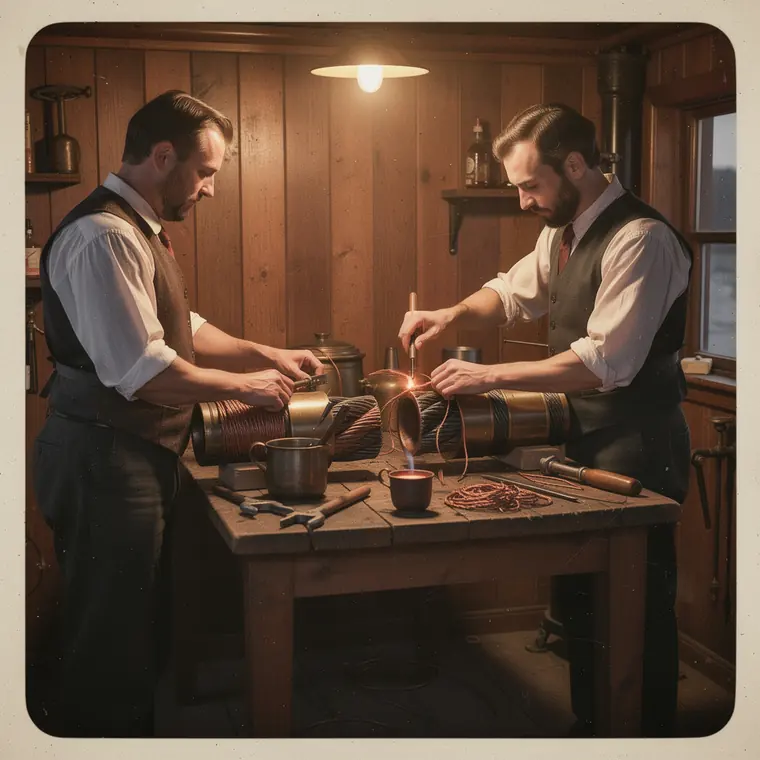
A jointer cabin aboard a cable ship where two cable ends are spliced: a small timber-walled cabin on deck, a workbench with the two cable ends laid across it, two jointers in shirtsleeves and waistcoats bent over the joint, the conductor strands scarfed together by hand and the gutta percha covering moulded over the tapered joint with heated irons and clamps, pots of gutta percha warming beside them, the thick armoured cable running in from the deck through the cabin, human hands doing the work.
- What it was used for
- Splicing and testing aboard ship. On 13 July 1866 the shore end was carried into a little covered hut on deck, where it met the end brought from the after tank; the jointers unravelled Manila twist and iron wires, took off the gutta-percha, unwound the copper strands, rejoined them and re-insulated layer by layer, each layer coated with Chatterton's Compound. The London Daily News correspondent describes the work running from the moment the end came aboard in the forenoon until five minutes to three in the afternoon. Further down the deck the testing room worked night and day; in 1865 tests were passed from ship to shore every thirty minutes. Varley's condenser equalled the capacity of eighty-five miles of cable, and the resistance sets held 101 coils of 1,000 ohms each.
- What was new
- The joint was no longer a single event made under time pressure in at sea - in 1858, per Charles Bright, the trial splice in the Bay of Biscay ran from 4 p.m. to 5.15 while the ships lay hove to - but one step inside a line under continuous watch: a fault showed within seconds, while the ship still stood over it. On the name: "splicing chamber" is not a period term; the sources say testing-room, electricians' room, and for the joint itself a covered hut on deck. The barb is in Henry M. Field's 1865-voyage account: the two best cable electricians aboard, Thomson and Varley, were not allowed to interfere or even to give advice unless asked in writing - and then it was to be given in writing. In 1866, per the Daily News, both were the company's consulting electricians.
Connections
Every connection names its kind. “Forerunner” on its own would be a claim.
- Works withCable Tank1865When the after tank ran empty in 1866, its last turn slid down to the spliced rope already brought along the trough from the forward tank. Deane's diary, printed by Field, names Canning, Clifford and Temple for the change-over; at 1.11 a.m. Greenwich time the fresh cable was going over the stern.Source: Henry M. Field, The Story of the Atlantic Telegraph (1892), Kap. XVI 'Victory at Last' (Project Gutenberg): Wechsel vom achteren zum vorderen Tank
- Works withKabelleger Great Eastern1866On Friday, 13 July 1866, the shore cable was lifted from the seabed, brought over the Great Eastern's stern and spliced to the main cable. Then signals went through the whole length on board and back to Valentia: 2,440 nautical miles, reported perfect.Source: Henry M. Field, The Story of the Atlantic Telegraph (1892), Kap. XVI 'Victory at Last' (Project Gutenberg): Spleißung des Küstenkabels am 13. Juli 1866