Dreadnought
1906 · Turbine Battleship · Work 195 of 1,871
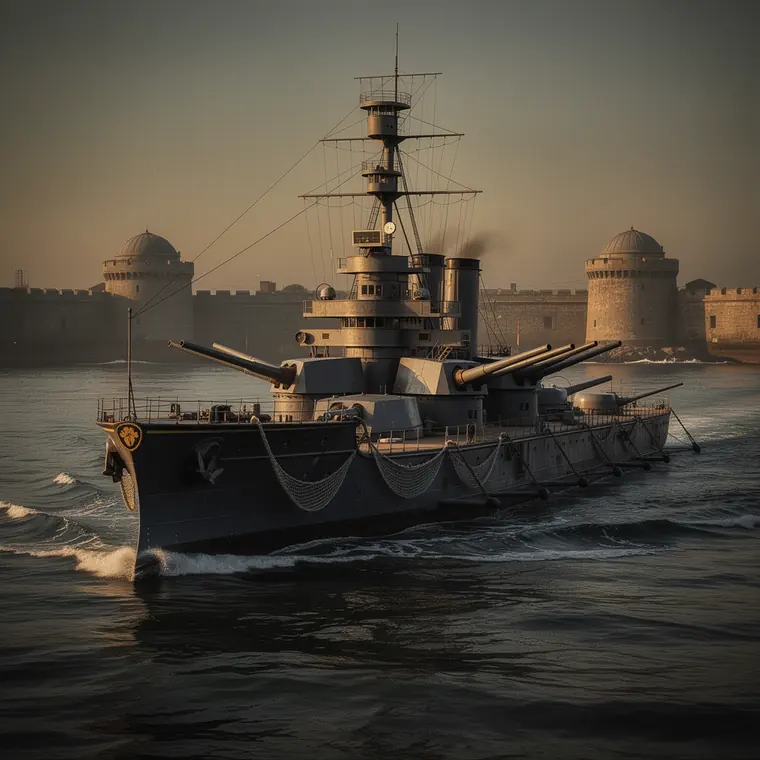
HMS Dreadnought steaming out of Portsmouth, five twin twelve inch turrets, tripod foremast carrying a control top, two funnels, torpedo nets stowed on booms along the hull, harbour forts behind.
- What it was used for
- Royal Navy battleship, built at Portsmouth Dockyard; Royal Museums Greenwich attributes the design to Admiral Sir John Fisher. Ten 12-inch guns in five twin turrets, eight of which could fire on either side, 18,000 tons, 21 knots (Royal Naval Museum, Portsmouth). From the Navy List and Admiralty papers, The Dreadnought Project dates the keel laying to 2 October 1905, the launch to 10 February 1906 and commissioning to 2 December 1906. The Admiralty quoted a building cost of £1,680,000, which, as Angus Ross reports, William H. White in 1906 thought a gross under-estimate.
- What was new
- Contemporaries, says Royal Museums Greenwich, usually mounted only four big guns; she had ten, and her turbines gave 21 knots, three more than battleships with traditional piston engines. The idea had been described earlier: Angus Ross renders Vittorio Cuniberti's design in Jane's Fighting Ships for 1903 as "an Ideal battleship for the British Fleet" – I did not find the original passage, so no quotation from Cuniberti's own text appears here. The barb: the Royal Naval Museum writes that she started a naval building race that only ended after the First World War; she was absent from Jutland, and remained the only battleship to sink a submarine, when she rammed U 29 in March 1915 – the day varies: usually 18 March (uboat.net, J. Rickard), 29 March at Royal Museums Greenwich. Angus Ross also judges that by forcing her through in just over a year Fisher saddled himself with a standard that was unsustainable in the longer term, where two years was the norm.
Connections
Every connection names its kind. “Forerunner” on its own would be a claim.
- Follows fromTurbinia1897Turbinia ran before the Admiralty at the Spithead review on 26 June 1897. The ASME account says that appearance accelerated "the acceptance of the steam turbine" on ships; IEEE Spectrum dates the Admiralty's decision that all future vessels be turbine powered to 1905. This ship's keel was laid on 2 October 1905.Source: ASME-Landmark: Turbinia, Engineering and Technology History Wiki · IEEE Spectrum: This British Family Changed the Course of Engineering · The Dreadnought Project: H.M.S. Dreadnought (1906) (Laid down: 2 Oct, 1905)
- Follows fromParsons Steam Turbine1884Grace's Guide records of Parsons: "The Admiralty, after trying turbines in destroyers and in the 'Amethyst,' adopted them in 1905 for the 'Dreadnought,' and later ships." The road ran through destroyers and a cruiser before the reaction principle of 1884 reached a battleship.Source: Grace's Guide: Charles Algernon Parsons · ASME-Landmark: Turbinia, Engineering and Technology History Wiki
Further reading
- Royal Museums Greenwich, Objekt 67323, Dreadnought (1906)
- Royal Naval Museum, Portsmouth Historic Dockyard, HMS Dreadnought Exhibition (Internet Archive, Fassung vom 3. Oktober 2012)
- The Dreadnought Project, H.M.S. Dreadnought (1906), nach Navy List und ADM-Akten
- Angus Ross, HMS Dreadnought (1906) – A Naval Revolution Misinterpreted or Mishandled?, The Northern Mariner XX/2 (2010), S. 175–198
- J. Rickard, HMS Dreadnought (historyofwar.org)
- uboat.net, WWI U-boats: U 29