Turbinenrotor der Mauretania
1906 · Parsons Turbine · Work 199 of 1,871
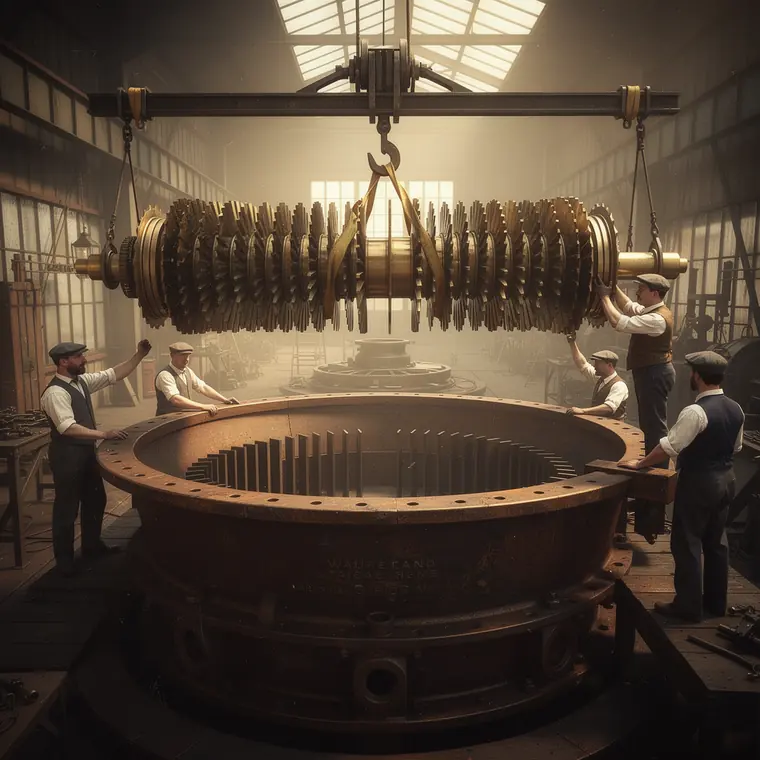
A Parsons turbine rotor for the Mauretania being lowered into the open lower half of its cast casing at the Wallsend works, the rotor a long solid steel drum on a shaft with rank upon rank of short closely-set blades ringing the drum in complete circles along its whole length, the casing half beneath it lined with matching rows of fixed blades, overhead crane chains taut, fitters guiding it into place in cloth caps, waistcoats and shirtsleeves, the hall lit by daylight through the roof glazing.
- What it was used for
- The four Parsons turbines drove the Mauretania on Cunard's Liverpool–New York service. National Museums Liverpool records that the government lent Cunard £2.6 million for two new speedsters, and that "The ships had to be built to Admiralty standards so that they could serve as armed merchant cruisers in time of war". The plant had to deliver sustained full power rather than peaks: The Lusitania Resource gives 68,000 horsepower at delivery and 76,000 on her record-setting run. Grace's Guide, in its company entry for the Wallsend Slipway, gives the rated output as 70,000 shaft horsepower.
- What was new
- The leap was one of scale: four turbines for 68,000 horsepower between them in a single hull. The low-pressure rotor drums were fluid-compressed steel forged at Openshaw by Armstrong, Whitworth ("Engineering", 8 November 1907). Mauretania had two extra stages of blading in her forward turbines that Lusitania did not, according to The Lusitania Resource, which cites no source for it. The barb: the turbine bought speed, not economy. National Museums Liverpool puts the cost at £1,625,463 for Lusitania and £1,812,252 for Mauretania, £837,715 more between them than the government loan that funded them, and records that both ships were initially troubled by vibration, "particularly at high speed". Rotor diameter, blade count and rotor weight I could not find in any source.
Connections
Every connection names its kind. “Forerunner” on its own would be a claim.
- Works withMauretania1907The rotor is part of one of the four turbines that drove this ship. Grace's Guide records of the Wallsend Slipway and Engineering Co.: "The Company constructed all four turbines of 70,000 s.h.p for the Mauretania." The low-pressure rotor drums were forged at Armstrong, Whitworth's Openshaw works.Source: Grace's Guide: Wallsend Slipway and Engineering Co
- Follows fromParsons Steam Turbine1884The Wallsend Slipway and Engineering Co. built Parsons turbines under licence, among them all four of the Mauretania's; Grace's Guide: "The company manufactured Parsons turbines under licence for ships including the famous RMS Mauretania". Parsons had filed the basic design in 1884; the ASME landmark account names "a patent for a compound reaction steam turbine".Source: Grace's Guide: Wallsend Slipway and Engineering Co · ASME-Landmark: Turbinia, Engineering and Technology History Wiki
- Follows fromTurbinia1897Writing for the Maritime Foundation, Richard Maudsley says Turbinia's appearance at Spithead in 1897 led within a few years to the Navy specifying turbine propulsion; "This was soon followed by commercial ships, notably the Cunard liners Mauretania and Lusitania in 1907". The Mauretania's four turbines, 70,000 shaft horsepower in all, were built by the Wallsend Slipway and Engineering Co.Source: The Maritime Foundation (Richard Maudsley): Sir Charles Parsons and the birth of the steam turbine · Grace's Guide: Wallsend Slipway and Engineering Co
Further reading
- The Lusitania Resource, Mauretania Specifications
- Engineering, 8. November 1907 (Transkript bei Grace's Guide, Wallsend Slipway and Engineering Co)
- National Museums Liverpool, Lusitania: cost overruns and teething troubles
- National Museums Liverpool, Lusitania – to save the company
- The Lusitania Resource, Mauretania Design and Construction