Turbinenrotor der Mauretania
1906 · Parsons Turbine · Werk 199 von 1.871
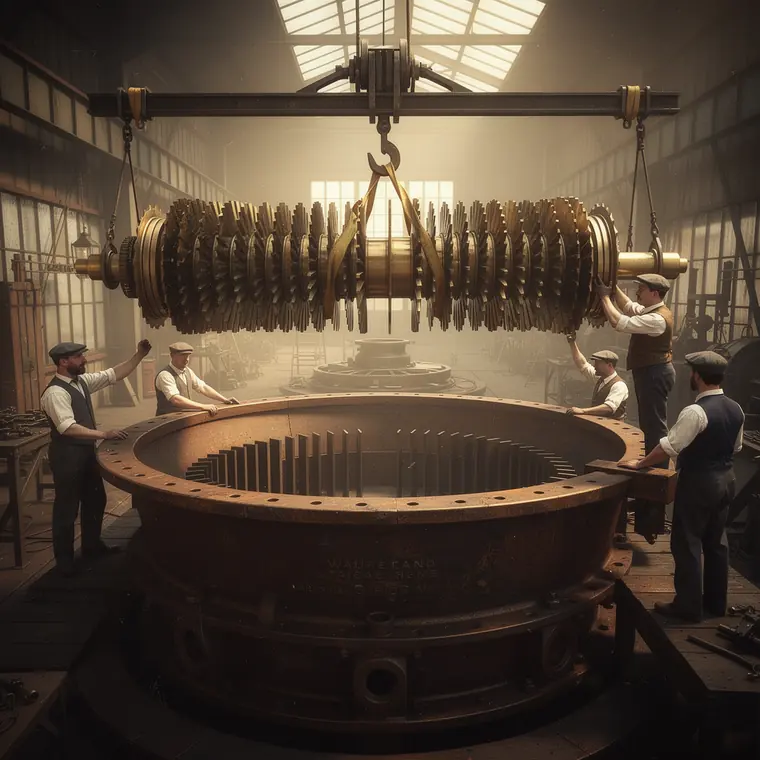
A Parsons turbine rotor for the Mauretania being lowered into the open lower half of its cast casing at the Wallsend works, the rotor a long solid steel drum on a shaft with rank upon rank of short closely-set blades ringing the drum in complete circles along its whole length, the casing half beneath it lined with matching rows of fixed blades, overhead crane chains taut, fitters guiding it into place in cloth caps, waistcoats and shirtsleeves, the hall lit by daylight through the roof glazing.
- Wofür es benutzt wurde
- Die vier Parsons-Turbinen trieben die Mauretania im Cunard-Dienst Liverpool–New York. National Museums Liverpool schreibt, die Regierung habe Cunard ein Darlehen von 2,6 Millionen Pfund für zwei Schnelldampfer gegeben, und: "The ships had to be built to Admiralty standards so that they could serve as armed merchant cruisers in time of war". Die Anlage musste Dauerhöchstleistung liefern, nicht Spitzen: The Lusitania Resource nennt 68.000 PS bei der Ablieferung und 76.000 auf der Rekordfahrt. Die Nennleistung gibt Grace's Guide im Firmeneintrag der Wallsend Slipway mit 70.000 shp an.
- Was daran neu war
- Der Sprung lag in der Größe: vier Turbinen für zusammen 68.000 PS in einem einzigen Rumpf. Die Niederdruck-Rotortrommeln waren aus fluidgepresstem Stahl, geschmiedet bei Armstrong, Whitworth in Openshaw ("Engineering", 8. November 1907). Die Mauretania hatte in den vorderen Turbinen zwei Schaufelreihen mehr als die Lusitania, so The Lusitania Resource, die dafür keinen Beleg nennt. Widerhaken: die Turbine brachte Geschwindigkeit, nicht Wirtschaftlichkeit. National Museums Liverpool rechnet 1.625.463 Pfund für die Lusitania und 1.812.252 für die Mauretania, zusammen 837.715 Pfund mehr als das Regierungsdarlehen, und beide Schiffe hätten anfangs unter Vibrationen gelitten, "particularly at high speed". Rotordurchmesser, Schaufelzahl und Rotorgewicht habe ich in keiner Quelle gefunden.
Zusammenhänge
Jeder Verweis nennt seine Art. „Vorläufer“ allein wäre eine Behauptung.
- Wirkt zusammen mitMauretania1907Der Rotor ist Teil einer der vier Turbinen, die dieses Schiff antrieben. Grace's Guide hält zur Wallsend Slipway and Engineering Co. fest: "The Company constructed all four turbines of 70,000 s.h.p for the Mauretania." Die Niederdruck-Rotortrommeln wurden bei Armstrong, Whitworth in Openshaw geschmiedet.Beleg: Grace's Guide: Wallsend Slipway and Engineering Co
- Folgt ausParsons Steam Turbine1884Die Wallsend Slipway and Engineering Co. baute Parsons-Turbinen in Lizenz, darunter alle vier Turbinen der Mauretania; Grace's Guide: "The company manufactured Parsons turbines under licence for ships including the famous RMS Mauretania". Das Grundmuster hatte Parsons 1884 angemeldet; die ASME-Landmark-Darstellung nennt "a patent for a compound reaction steam turbine".Beleg: Grace's Guide: Wallsend Slipway and Engineering Co · ASME-Landmark: Turbinia, Engineering and Technology History Wiki
- Folgt ausTurbinia1897Richard Maudsley schreibt für die Maritime Foundation, Turbinias Auftritt in Spithead 1897 habe binnen weniger Jahre dazu geführt, dass die Navy Turbinenantrieb vorschrieb; "This was soon followed by commercial ships, notably the Cunard liners Mauretania and Lusitania in 1907". Die vier Turbinen der Mauretania, zusammen 70.000 Wellen-PS, baute die Wallsend Slipway and Engineering Co.Beleg: The Maritime Foundation (Richard Maudsley): Sir Charles Parsons and the birth of the steam turbine · Grace's Guide: Wallsend Slipway and Engineering Co
Zum Weiterlesen
- The Lusitania Resource, Mauretania Specifications
- Engineering, 8. November 1907 (Transkript bei Grace's Guide, Wallsend Slipway and Engineering Co)
- National Museums Liverpool, Lusitania: cost overruns and teething troubles
- National Museums Liverpool, Lusitania – to save the company
- The Lusitania Resource, Mauretania Design and Construction