Mallard
1938 · LNER Class A4 · Work 2 of 1,871
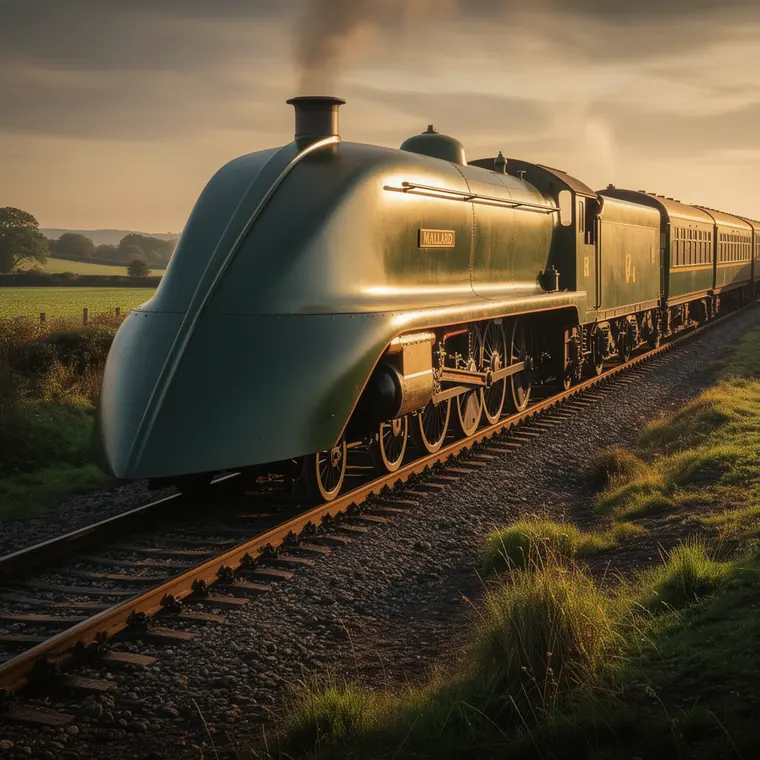
A streamlined locomotive carrying a small plate reading "Mallard", its front forming a sharp downward wedge with a flat vertical face at the very tip, side valances sweeping low over three pairs of tall driving wheels, at speed on a falling gradient through open farmland.
- What it was used for
- LNER express services on the East Coast Main Line — and one afternoon that still counts.
- What was new
- Streamlining was no novelty by 1938. The combination was: boiler pressure, double chimney and casing together produced 126 mph on the falling grade of Stoke Bank on 3 July 1938 — the highest speed ever recorded for a steam locomotive, still. Two things belong with the figure if it is to stay honest. It was a peak over one second; the speed held for five seconds was 125 mph. And the run cost something: the middle big-end bearing overheated, Mallard was taken off the train at Peterborough and sent to Doncaster works. The record stands; the machine did not finish the journey.
Connections
Every connection names its kind. “Forerunner” on its own would be a claim.
- Follows fromPacific Chapelon1940The double Kylchap exhaust that gave Mallard part of its 126 mph on 3 July 1938 is Chapelon's design of 1926-29, seen here on the 231E of 1940. Gresley adopted it for the A4 class. The work's date is that of the rebuild, not of the exhaust.Source: Wolfgang A. Fengler / Davidson A. Ward: The Development of Modern Steam 1 - André Chapelon and his Steam Locomotives, Coalition for Sustainable Rail, 2013 · Advanced Steam Traction (AST Group): Kylchap, Kylpor and Lempor Exhausts
- Follows fromFlying Scotsman1923Flying Scotsman reached 100 mph on a test run in 1934. According to the National Railway Museum this proved to the LNER's directors that steam could deliver high speeds and negated a plan to use diesel on high-speed services. After Papyrus ran 108 mph in 1935, Gresley's A4 was authorised as a streamlined development of the A3, with boiler pressure raised from 220 to 250 psi.Source: The history of Flying Scotsman (National Railway Museum) · A4 (The Gresley Society Trust) · The Gresley A4 Pacifics (LNER Encyclopedia) - Kesseldruck 220 auf 250 psi