Levers Lace Machine
1813 · Leavers Lace Machine · Work 306 of 1,871
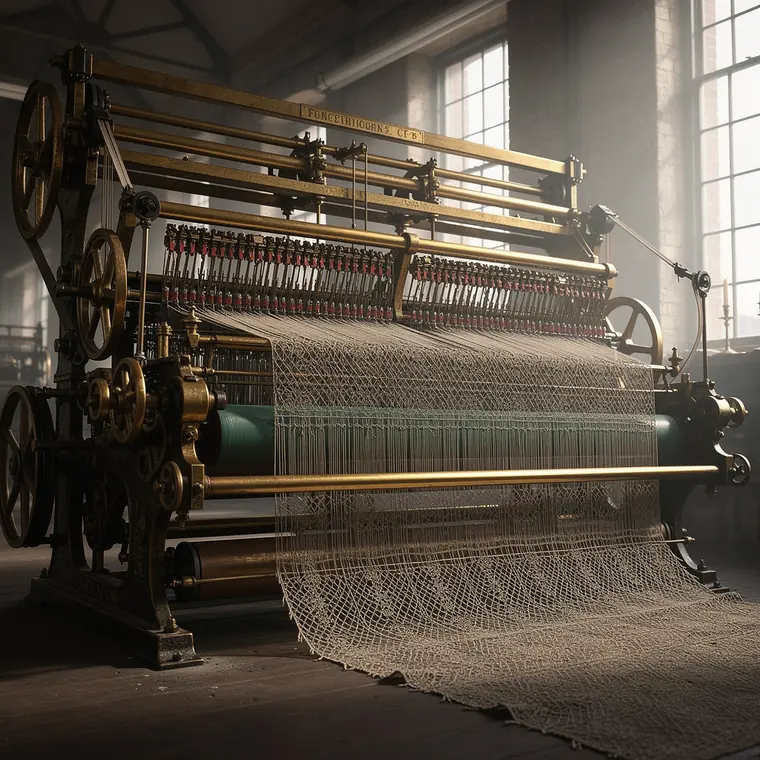
John Levers' lace machine in a Nottingham workshop, rows of thin carriages rocking through the warp on curved combs, finished net running away onto the take-up roller.
- What it was used for
- John Levers, a frame smith from Sutton-in-Ashfield, built an 18-inch machine in a garret off the Derby Road in Nottingham in 1812 and 1813, so secretly that not even his family saw it. The lace house of Stevenson and Skipwith financed the run: another 18-inch, a 27-, a 36-, a 45- and two 54-inch machines, worked in a shop in St James's Street; at first it was called Stevenson's frame. About 1814 John Farmer worked a 54-inch machine with a second man, five hours each by turns, the machine running twenty hours a day. M. Aubry reported for the 1851 exhibition that English plain cotton net had once been 40 francs the square yard and was 3d. in 1851; Felkin, who reproduces him, corrects that to 4d. as the lowest figure.
- What was new
- The 1813 machine made net, not pattern; patterning came decades later through the Jacquard, with Samuel Draper's patents of 1834 and 1835 and Hooton Deverill's patent No. 8955 of 1841, which Felkin himself reports only as alleged to be the first really successful application. What Levers added was putting all carriages and bobbins in a single tier instead of two. That forced them to half thickness and demanded finer combs, a stiff frame free of vibration and faultless workmanship throughout; on a Levers machine often thirty carriages and bobbins work safely together edgewise within the space of an inch. It was the execution of an idea which, on Felkin's account, Heathcoat himself had had but not carried out. Whether one Turton had a hand in it Felkin leaves expressly open: it is said, but without any evidence.
Connections
Every connection names its kind. “Forerunner” on its own would be a claim.
- Follows fromHeathcoat Bobbinet1808Felkin 1867, p. 271: Levers's machine of 1813 was "another modification of the patent or 'Old Loughborough' machine", carrying out the idea Heathcoat himself had entertained of placing all carriages and bobbins in one tier. Heathcoat's specification was by then well known to the artisans of Nottingham.Source: William Felkin, A History of the Machine-wrought Hosiery and Lace Manufactures, London 1867, S. 271-272
- Works withThe Jacquard Head1804On Felkin's account a Jacquard apparatus on the Levers machine selects the levers and springs that pull or push the pierced bars sideways, a task formerly done by knobs on wheels or cylinders. A store curtain may call for ten or twelve thousand cards. It became general through Hooton Deverill's patent of 1841, which Richard Birkin bought and perfected on the bars of the Levers machine.Source: William Felkin, A History of the Machine-wrought Hosiery and Lace Manufactures, London 1867, S. 356-359, 364 und 370
Further reading
- William Felkin, A History of the Machine-wrought Hosiery and Lace Manufactures, London 1867, S. 271-274, 360-361, 414, 418-419
- Nottingham City Museums, Leavers Lace Machine, Objekt NIM 1964-17 (von John Levers zwischen 1828 und 1840 gebaut)
- Grace's Guide: John Levers (keine Patente; 1821 nach Rouen, in Frankreich gestorben; drei Namensträger John Levers)