Archimedes Model A
1906 · Stepped Drum · Work 413 of 1,871
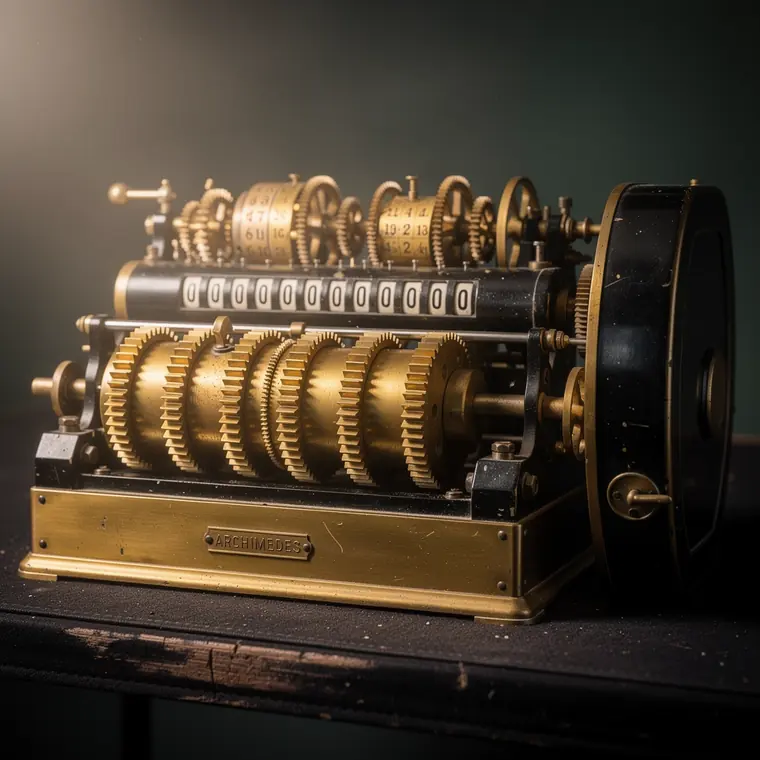
A stepped-drum calculating machine from a Saxon workshop with its cover removed, a row of eight brass cylinders lying parallel on a single shaft, each cylinder carrying stepped teeth of increasing length like a small staircase wound round the drum, brass gearing meshing above them, the black enamelled carriage and its row of numeral windows behind, each window showing the single digit 0, the lifted cover leaning against the case, every other surface plain brass and black enamel, a maker's plate on the front reading "Archimedes", standing on a dark baize-covered table before a deep neutral background, a single raking light from the left raking across the stepped teeth.
- What it was used for
- A stepped-drum machine by R. Pöthig of Glashütte, Saxony. The historical calculating machine collection of TU Dresden gives the Model A as 8 places of slider setting, 9 places of revolution counter and 16 places of result register; the revolution counter has no tens carry. The firm had been founded in 1890 by Constantin Fischer; Reinhold Pöthig joined as a partner in 1899 and was sole owner from 1900. From about 1920 Hans Sabielny took over distribution, first in Germany and then worldwide. On the count by Reichel (2006) cited in Rechnerlexikon, just under 60 years produced 42 machine types in roughly 85,000 examples. The last mechanical machine left Glashütte in 1960; the works were later absorbed into VEB Robotron.
- What was new
- No new design. TU Dresden states that the Model A differs only slightly from earlier Glashütte products. The dating is not settled either: in its article on Glashütte production Rechnerlexikon says Pöthig built his own stepped-drum machines from 1904, while its Archimedes article gives 1906 as the start of machines under that name; TU Dresden dates its Model A to 1906 and refers to first machines of 1904. All that can be supported is first machines of his own from 1904; whether the name Archimedes was on them from 1904 or only from 1906 the sources leave open. What was new, on Reichel's account, was less the mechanism than Pöthig's aim of reducing and standardising parts so as to offer a varied range of models at competitive prices.
Connections
Every connection names its kind. “Forerunner” on its own would be a claim.
- Follows fromBurkhardt Arithmometer1878Reinhold Pöthig trained as a mechanic with Arthur Burkhardt in Glashütte, took over an existing workshop in 1904 and began production of his "Archimedes" in 1906. The Arithmeum lists the Burkhardt Arithmometer among the models that Model A follows.Source: Arithmeum, Sammlung Rechnen einst: Archimedes A
- Follows fromThomas Arithmomètre1851The Arithmeum names 'the Thomas Arithmomètre and the Burkhardt Arithmometer' as the models for Model A, built from 1906; like them it is still housed in a wooden case. Pöthig's patent DE 179755 is titled 'changeover device for Thomas-type calculating machines'. Among its improvements the Arithmeum lists clearing the carriage registers by pulling a lever.Source: Arithmeum, Sammlung Rechnen einst: Archimedes A