Royal Albert Bridge
1859 · Wrought Iron Lenticular Truss · Work 43 of 1,871
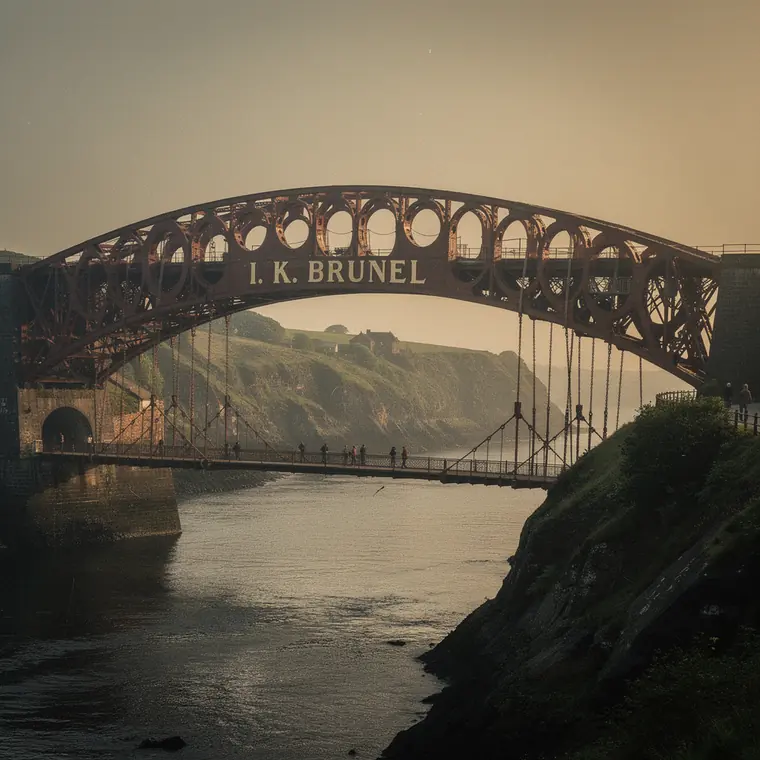
The Royal Albert Bridge at Saltash, two lenticular spans each pairing an oval wrought iron tube above with suspension chains below, the engineer's name lettered across the portal.
- What it was used for
- A railway bridge of the Cornwall Railway over the Tamar at Saltash, opened by Prince Albert on 2 May 1859, public services from 4 May. It was and remains the only rail crossing into Cornwall and today carries the Cornish Main Line. It was built single track because a double track version was judged unaffordable - and single track it has stayed. Total length 666.8 m, two main spans of 455 feet (138.7 m) each.
- What was new
- The structure combines a curved tubular top chord in compression with chains in tension to form a lenticular truss; the horizontal thrusts of the two cancel, so the piers carry no horizontal load. Lenticular trusses existed before; what was new was building one at this size with a compression tube in place of a trussed top chord. For the central pier an iron cylinder 11.3 m across and 27.4 m tall was sunk in May 1854 and lined under compressed air; the masonry was not finished until November 1856. Brunel was too ill to attend the opening, was represented by Robert Brereton and died on 15 September 1859 - he never saw the bridge in service.
Connections
Every connection names its kind. “Forerunner” on its own would be a claim.
- Follows fromBritannia Bridge1850At Stephenson's request Brunel helped float the Conway and Britannia tubes in 1848–50. At Saltash the trusses were floated out on pontoons in 1857 and 1858 and jacked up, in 1858 under Brereton; but the piers were built up beneath each truss instead of standing ready. The 1853 ironwork contract went to Charles Mare, who had built the ironwork of the Britannia Bridge.Source: Isambard Brunel, The Life of Isambard Kingdom Brunel, Civil Engineer (London 1870), Kapitel über die Royal Albert Bridge · Network Rail Corporate Archive: 033/034/035 – Royal Albert Bridge
- Follows fromThames Tunnel1843The sinking cylinder of the centre pier carried a diving bell under a dome. Brunel had formed that idea twenty years earlier on the Thames Tunnel, where his father weighed it for sinking the shafts; a similar patent of Cochrane's from 1830 partly deterred him then. For the Cornwall Railway Brunel took it up again: a trial cylinder in 1848, the great cylinder from 1853.Source: Isambard Brunel, The Life of Isambard Kingdom Brunel, Civil Engineer (London 1870), zum großen Zylinder des Mittelpfeilers · Grace's Guide: Thomas Cochrane (Patent 1830 auf Druckluft im Tunnelbau, mit Bezug auf Rotherhithe)