The Diagonal Board
1940 · Welchman's Diagonal Board · Work 472 of 1,871
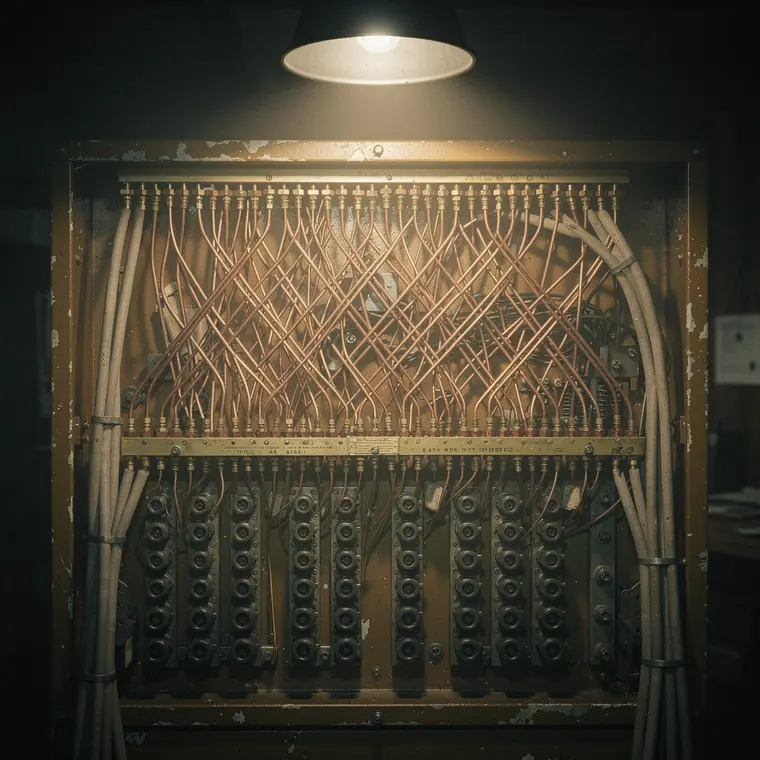
The rear of a cryptanalytic machine, a dense lattice of six hundred and seventy-six wires soldered between two rows of terminals, the wires crossing diagonally in a thick woven mass that hides the panel behind, vertical strips of cable sockets in groups of three along the rear, cloth covered cables bundled down the sides, a bronze coloured cabinet frame around it, a single work lamp from above at an angle, tinned copper and brass terminals catching the light, the hut behind in darkness.
- What it was used for
- An add-on unit for the British Bombe at Bletchley Park, the electromechanical machine that ran through rotor orders and plugboard hypotheses for the German Enigma. Per the Rutherford Journal each Bombe carried 36 sets of three drums in three banks of twelve; a run took about 18 minutes and tested three rotor orders at once. The board wired in the reciprocity of the plugboard: if G is plugged to R, then R is plugged to G. TNMOC dates the first machine of this kind, Agnus Dei or Agnes, to August 1940. By the end of the war 211 Bombes were running, worked by almost 1676 WRNS women and 263 RAF personnel against 3000 to 5000 intercepted Enigma messages a day.
- What was new
- Not a machine against Enigma - the Polish bomba and Turing's design came first. What was new was a wiring that took the plugboard out of the calculation. Turing's method, per the Rutherford Journal, needed menus with at least three closed loops; Welchman's board drew conclusions from the symmetry of each stecker pair, so shorter cribs with few or no loops became usable. The Bombe Rebuild Project puts the reduction of the search space at 158 million million million down to 1,054,560 possibilities. The price: the machine produced no decrypt, only a shortlist. Even with the board, the Rutherford Journal reports about four false stops per rotor order tested on a typical menu, each to be eliminated by hand.
Connections
Every connection names its kind. “Forerunner” on its own would be a claim.
- Works withThe Turing–Welchman Bombe1940Welchman's diagonal board exploits the reciprocal wiring of the Enigma plugboard: if A is plugged to B, then B is plugged to A. It is permanently wired as a square matrix in columns 1, 4 and 7 of the gate at the back of the Bombe, with 338 wires per column. GCHQ calls it a dramatic improvement to Turing's Bombe.Source: GCHQ: Gordon Welchman · Bombe Rebuild Trust: Bombe Description · B. Naskręcki (Adam-Mickiewicz-Universität Posen), Kapitel 12: Bletchley Park and the Bombe
- Follows fromEnigma I with Plugboard1932Welchman designed the diagonal board around the reciprocal nature of the Enigma plugboard: if G is steckered to R, then R is steckered to G. The board is 26 jacks of 26 contacts each, permanently wired so that A connects to f and F to a. That took the plugboard out of the bombe's calculation.Source: Turing Welchman Bombe Rebuild Project: Enter Turing and Welchman · Turing Welchman Bombe Rebuild Project: Bombe Description · Center for Cryptologic History (NSA): Solving the Enigma - History of the Cryptanalytic Bombe