Difference Engine No. 2, Completed
1991 · Difference Engine No. 2 · Work 517 of 1,871
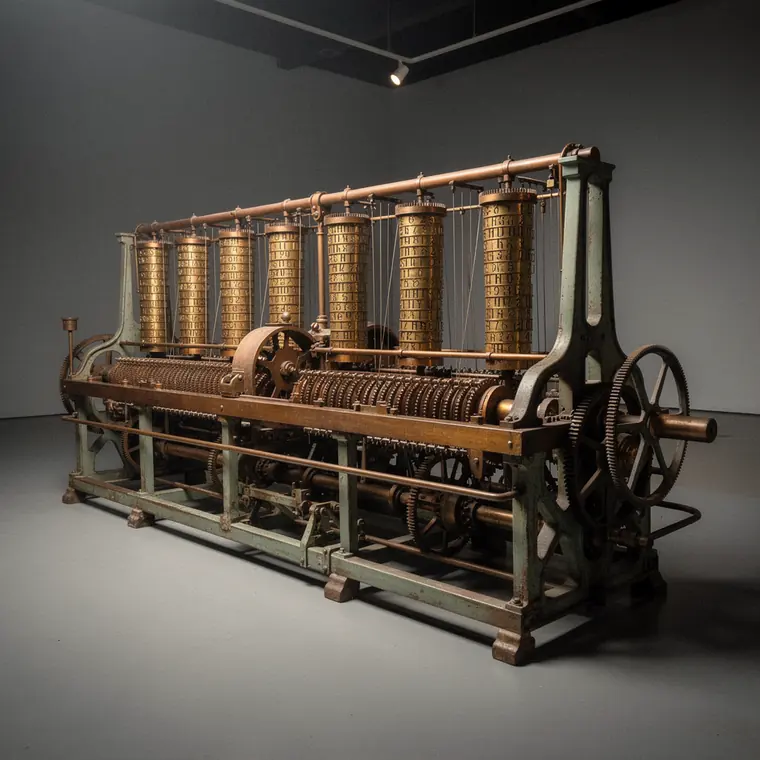
A complete difference engine eleven feet long and five tons in weight, eight columns of brass figure wheels ranged in a row, each column a stack of wheels one above the other behind a heavy bronze and steel frame, the crank at one end, brass warm against grey steel, the engine standing finished in a museum gallery on a plain grey floor before a flat grey wall, even flat light from directly in front.
- What it was used for
- Difference Engine No. 2 is a calculating machine of bronze, cast iron and steel that computes numerical tables. Charles Babbage drew it between 1847 and 1849 and never built it. The Science Museum in London began planning in 1985 and in 1991, for the bicentenary of Babbage's birth, completed the calculating section from the drawings in its own archive. The work was led by Doron Swade, then the museum's curator of computing. The calculating section has some 4,000 parts and 248 figure wheels; it calculates to thirty-one decimal places and works with seventh-order differences. Four turns of the crank make one complete calculating cycle. The whole machine is about eleven feet long, seven feet high and weighs five tonnes. It stands in the museum and is demonstrated there.
- What was new
- What was new was not a working calculating machine. Difference engines had already worked: Georg and Edvard Scheutz built ones in the 1850s that calculated and printed tables. What was new was the proof that this design holds - one hundred and forty-two years after the drawings, at Babbage's own scale of thirty-one digits and seventh-order differences, where the Scheutz machines worked to fifteen digits and fourth-order differences. The barb is in the date: only the calculating half was finished in 1991. The machine could compute to thirty-one places and write none of it down. The printing section followed only in 2002 - paid for not by the British state, which had closed Babbage's account in 1842, but by a private American, Nathan Myhrvold.
What the sources leave open: The figures (4,000 parts, 248 figure wheels, thirty-one digits, five tonnes, dimensions, four turns of the crank) are from the Science Museum's own publications. The statements about the Scheutz machines rest on the Computer History Museum and the Science Museum Group collection; they belong to works 496 and 497.
Connections
Every connection names its kind. “Forerunner” on its own would be a claim.
- Follows fromDifference Engine No. 2, the Design1849The Science Museum built the machine from Babbage's 1847-49 design for Difference Engine No. 2. The calculating section was finished in June 1991, in time for the bicentenary of Babbage's birth; the engine was never constructed in his lifetime.Source: Science Museum Group: Difference Engine No. 2, Objekt co526657 · Computer History Museum: The Engines - A Modern Sequel
- Follows fromMechanical Notation1826The Mechanical Notation comprises drawings (Forms), symbol strings (Trains) and timing diagrams (Cycles). For the rebuild, Forms and Cycles were the main sources from which the machine's operation was decoded; the symbolic language itself had not yet been fully decoded and was little used. The fully detailed timing diagram is the definitive reference for the engine as built.Source: Science Museum: Difference Engine No. 2 - Technical Description
Further reading
- Science Museum: Charles Babbage's Difference Engine No. 2 - Technical Description (PDF)
- Science Museum: Charles Babbage's Difference Engine No. 2 - User Manual (PDF)
- Science Museum: Charles Babbage's Difference Engines and the Science Museum
- Computer History Museum: This Day in History, September 23 (Georg Scheutz)
- Computer History Museum: The Babbage Engine - The Engines