Hand-Woven Core Plane
1953 · Core Memory · Work 620 of 1,871
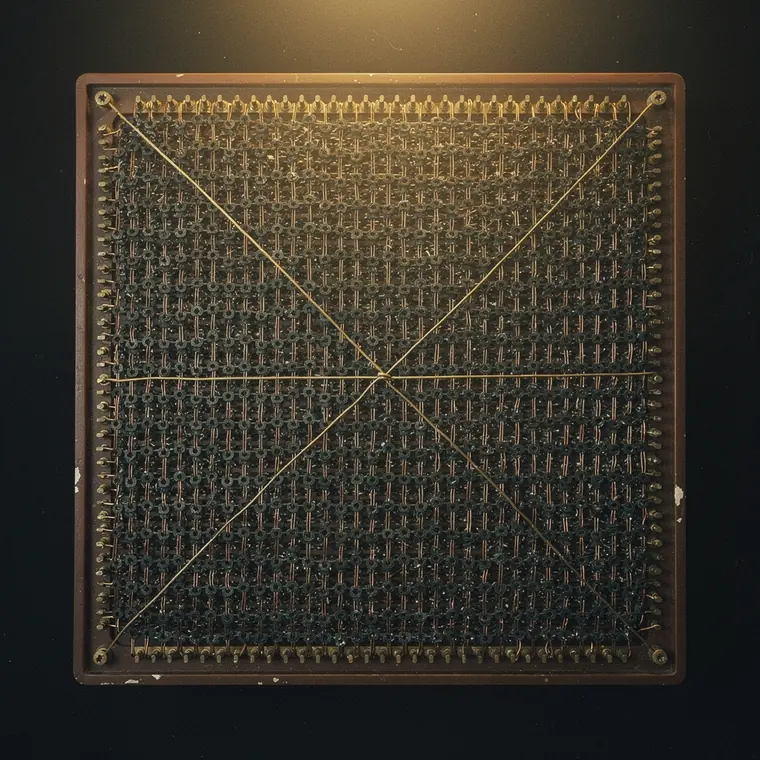
A full production core plane, a regular grid of thousands of tiny ferrite rings threaded on fine copper wires, four wires passing through each ring, one diagonal sense wire crossing the whole array at forty-five degrees, the regularity almost complete with only a few rings slightly askew, the plane framed in plain bakelite with rows of brass terminal pins, the matrix filling the frame edge to edge, soft backlight coming through the grid so the wires glow as fine lines and the rings show as a dense dark pattern, the plane alone against pure black.
The memory that sat in almost every computer until the 1970s was a textile: wires in two directions with a ferrite ring the size of a pinhead at every crossing. Each ring holds one bit by flipping magnetically one way or the other. It was threaded by hand, under a magnifier, ring by ring.
- What it was used for
- As working memory in almost every computer between 1955 and the early 1970s - from the mainframe in the machine room to the guidance computer aboard the Apollo flights.
- What was new
- Memory that does not forget when the power goes and has no moving parts. The delay lines before it had to keep sending their contents round in a circle; the drums had to spin. Several people have a claim to it - An Wang, Jay Forrester and Jan Rajchman were all working on it at once, and a patent dispute ran for years afterwards.
Connections
Every connection names its kind. “Forerunner” on its own would be a claim.
- Parallel toThe Jacquard Head1804Both store a pattern in a woven grid. In the Jacquard loom the punched card decides which warp threads rise; in the memory plane the current in two crossing wires decides which ring flips. The same form, with no documented descent between them.
- Parallel toFlying Shuttle1733Warp runs one way, weft across it, and the cloth exists at the crossing. In the memory plane two wires run exactly so, and the ring sits at the crossing.
- Works withThe Sense Wire1953Museum Waalsdorp describes it using the CDC 6600: besides the X and Y wires, further wires pass through every core of the plane, among them the diagonal sense wire. On reading, the flux change of a core that held a one and switches over is detected on this winding as a one.Source: Computer history: Core memory (Museum Waalsdorp)