The Piecework Rate
1958 · Assembly Payment · Work 624 of 1,871
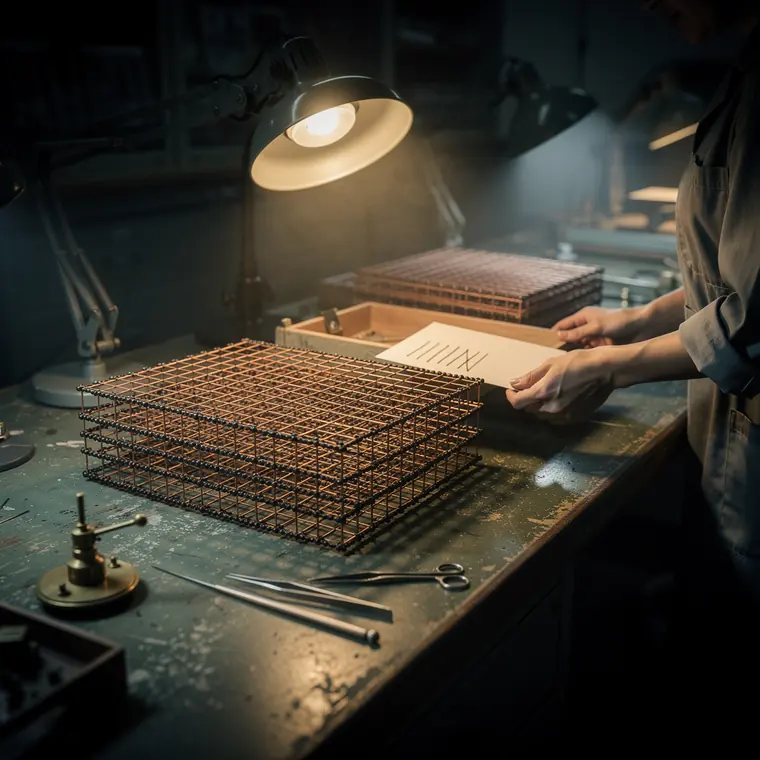
A core-memory assembly bench at the end of a shift in 1958, in the foreground a finished square memory frame about fifteen centimetres on a side strung with a fine mesh of copper wires and tiny dark ferrite rings, beside it a wooden tray holding a short stack of identical finished frames, a row of pencil tally strokes in groups of five on a small blank card clipped to the tray, a threading needle, tweezers and a magnifier lamp on the worn bench top, a woman's hands in a cotton work smock laying one more frame on the stack, further benches and lamps in soft focus behind.
- What it was used for
- The piecework rate belongs to the question of how the wiring of core memory planes was organised and paid for. In Rosner and others an IBM engineer describes a later form of this work: women and men with limited mobility threaded the sense wires at home, under contract, and a courier delivered and collected the memory planes every day. They were mostly mothers of school children, who wired the planes while the children were at school.
- What was new
- What was new here was not a device but a form of work: a core part of the digital computer was given out as home work. The material came to the house, the finished piece was collected. That is the shape of the putting-out system of the nineteenth-century weaving and needle trades, applied to the newest industry of its day. The barb: this form depended on the remnant of hand work the machines left over. According to an engineer quoted by Rosner and others, machines threaded the X and Y wires, but the diagonal sense wire remained hand work. According to Bashe and others, quoted by the computer museum of the University of Amsterdam, the time for a 64 by 64 plane fell from about 25 hours to 12 minutes once machines took over the threading.
What the sources leave open: No piecework rate for this work is documented in the sources consulted, and the year 1958 could not be confirmed either. The home work is known from a single source, Rosner and others 2018, whose citation at that point is incomplete and reads only “Edward Boyd. 2017.” This is the thinnest entry in this batch.
Connections
Every connection names its kind. “Forerunner” on its own would be a claim.
- Parallel toPay Day1885The same wage form in both pictures: pay follows the count of finished pieces, not the time spent. There is no evidence that one trade copied the other - only that the form is twice the same.
- Parallel toThe Wiring Room1955The rate card hangs on the wall of the room where the threading is done. One work shows the labour, the other shows what it is paid by.