The Landing Tables
1944 · Tide Computation · Work 646 of 1,871
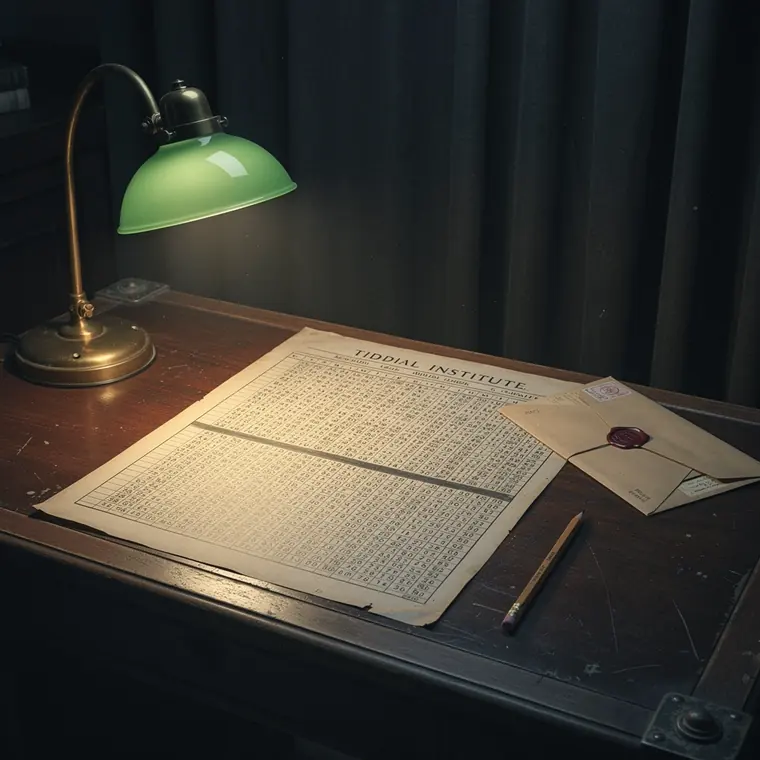
A desk in a tidal institute in wartime, a printed table lying on it, columns of closely set small figures with ruled lines between them seen at a shallow angle so the digits blur into a grey texture, one line marked in pencil, a sealed manila envelope with a red wax seal beside the table, a pencil, a blackout curtain drawn behind the desk, every object of wartime 1944 make, a single desk lamp with a green glass shade throwing its light on the paper, the rest of the office dark.
- What it was used for
- What is meant are the tide tables for the Normandy landings. The planners needed hourly water levels for beaches for which no measurement records existed. William Ian Farquharson, in charge of tides at the British Hydrographic Office, wrote Arthur Thomas Doodson a handwritten letter on 9 October 1943 asking for height predictions for four months from 1 April 1944. For secrecy he called the stretch of coast only "Position Z" and supplied estimated harmonic constants with the request. Doodson computed at Bidston on two machines: the Kelvin machine of 1924, overhauled in 1942, and the one designed by Roberts in 1906. They stood in separate rooms so that one bomb could not destroy both. In 1943 the technical staff consisted of Doodson and six young women, who did the calculations and took fire-watch duty besides.
- What was new
- What was unusual here was not an instrument but that a prediction was made for a place the computer did not know and for which almost no measurements existed. What was available were values for Le Havre and Cherbourg and three subsidiary stations whose tables themselves carried warnings about inaccuracy. Reconnaissance from boats and midget submarines brought only a few measurements, and because of shallow-water effects interpolation was unreliable. Farquharson knew this and wrote that he was working from estimated constants; how he arrived at them is not known, probably by adjusting the Le Havre values. The barb is twofold. Doodson, as he admitted years later, guessed from the constants that Normandy was meant — the secrecy did not keep the calculation secret. And by modern models Farquharson's estimated constants were good.
What the sources leave open: The basis is the article "D-Day: The Starting Point for Modern UK Oceanography" (Environment Coastal & Offshore) and Woodworth (2020). Farquharson's letter and the Admiralty files were not consulted in the original; the fuller account by Bruce Parker in Physics Today (2011), referred to by the first article, was not used. The first article dates the Kelvin machine to 1872; according to Woodworth it was built in 1924.
Connections
Every connection names its kind. “Forerunner” on its own would be a claim.
- Follows fromKelvin's Tide-Predicting Machine1876The tide predictions for the Normandy landings came at the Liverpool Tidal Institute from two machines that go back to Kelvin's first machine: the Bidston Kelvin Machine by Kelvin, Bottomley and Baird, bought in 1925 for about GBP 1500, and the Roberts-Légé Machine designed by Edward Roberts, who had helped Kelvin design the first machine.Source: P. L. Woodworth, Tide prediction machines at the Liverpool Tidal Institute, History of Geo- and Space Sciences 11 (2020), 15-29
- EncounteredThe Decca Outfit1944Normandy, June 1944: Doodson computed the tides for a place code-named Position Z without being told where it was; the harmonic constants came from Farquharson of the Admiralty. The Hydrographic Office adapted the predictions for each landing beach. Off the same beaches the Decca QM chain, transmitting from 5 June, kept the minesweepers on track.Source: Bruce Parker, The tide predictions for D-Day, Physics Today 64 (2011) · The Genesis of the Decca Navigator System, Journal of Navigation (Cambridge University Press)