The Decca Outfit
1944 · Phase Comparison Radio Navigation · Work 790 of 1,871
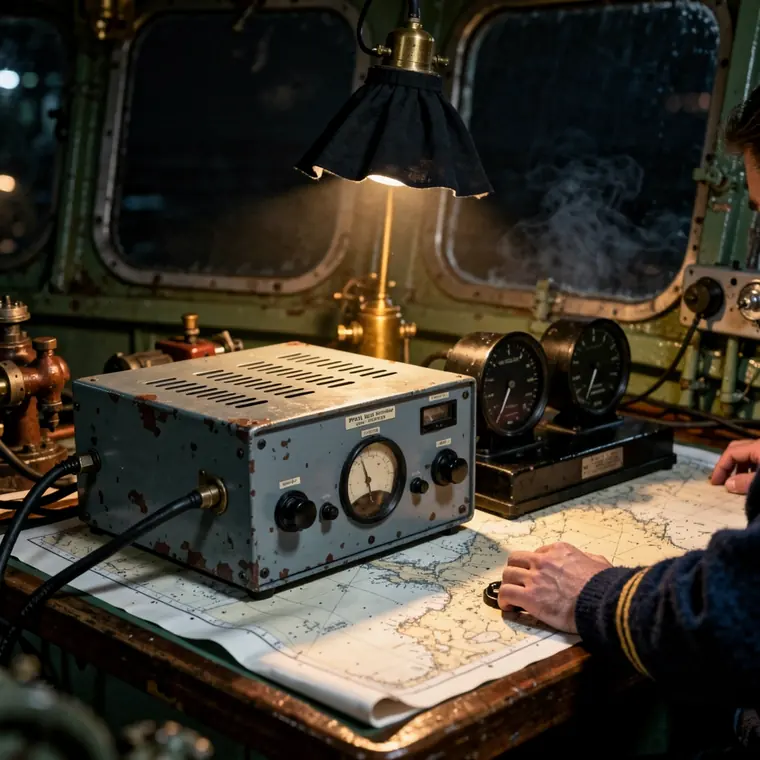
A phase comparison navigation receiver of 1944 on the chart table of a minesweeper in the Channel at night, a blue-grey metal box fifty centimetres wide, rows of ventilation slots in its lid, on its front a small round instrument face, plain and dim, three round black knobs and a thick cable, beside it on a flat black base two round counters, each a small round window, dark, with one thin pointer, a sea chart flat on the table, soft in focus, a hand in a dark blue woollen sleeve on one knob, a lamp hooded in black cloth throwing a narrow pool of light, the bridge windows black beyond.
- What it was used for
- The shipborne set of the Decca system, carried by the Admiralty as "Admiralty Outfit QM". It compared the phase of continuous-wave transmissions from a master and several slave stations and displayed position lines from them. According to the IET Archives, 21 minesweepers and other ships were fitted with QM; on 5 June 1944, 17 of them used it to cross the Channel, sweep minefields in the intended areas and mark the swept areas with buoys, in preparation for the Normandy landings. The same source gives more than 15,000 shipborne sets in use by 1970.
- What was new
- Decca compared the phase of continuous waves instead of pulses; according to the IET Archives, O'Brien's was not the first such system. The Admiralty Signal Establishment took up QM from October 1941 and tested it at sea in 1942 and again in 1943 and early 1944; in a direct comparison with Gee (code name QH), QM had the better sea-level range and accuracy, and was adopted for that reason. The barb: the system had been turned down twice. The US Army and Navy thought it too complicated and the work ended in 1939; Robert Watson-Watt examined it and did not pursue it because it was too easily jammed. O'Brien sent his papers in 1939 to Harvey J. Schwarz of the Decca Record Company - and the gramophone firm's name stuck to the navigation system.
Connections
Every connection names its kind. “Forerunner” on its own would be a claim.
- Parallel toThe Loran Receiver1942Two hyperbolic radio methods of the same war. In 1937 O'Brien conceived what became Decca, using phase comparison because pulse methods were then secret; US authorities did not consider it practical, and in 1939 Decca in London took it up. LORAN measured time delays and built on British GEE. In 1946/47 Decca kept clear of a band envisaged for a low-frequency Loran.Source: The Genesis of the Decca Navigator System, Journal of Navigation (Cambridge University Press) · A New Era in Time and Navigation, Smithsonian Time and Navigation
- EncounteredThe Landing Tables1944Normandy, 5 and 6 June 1944: the QM chain transmitted permanently from early on 5 June, apart from a 28-minute interruption, and kept the leading units of the minesweeping flotillas on steady courses over the ground. The tides for the same landing beaches had been predicted by Doodson in Liverpool; they were the key factor in choosing 5, 6 and 7 June.Source: The Genesis of the Decca Navigator System, Journal of Navigation (Cambridge University Press) · Bruce Parker, The tide predictions for D-Day, Physics Today 64 (2011)