Trevithick High-Pressure Engine
1800 · High Pressure Engine · Work 86 of 1,871
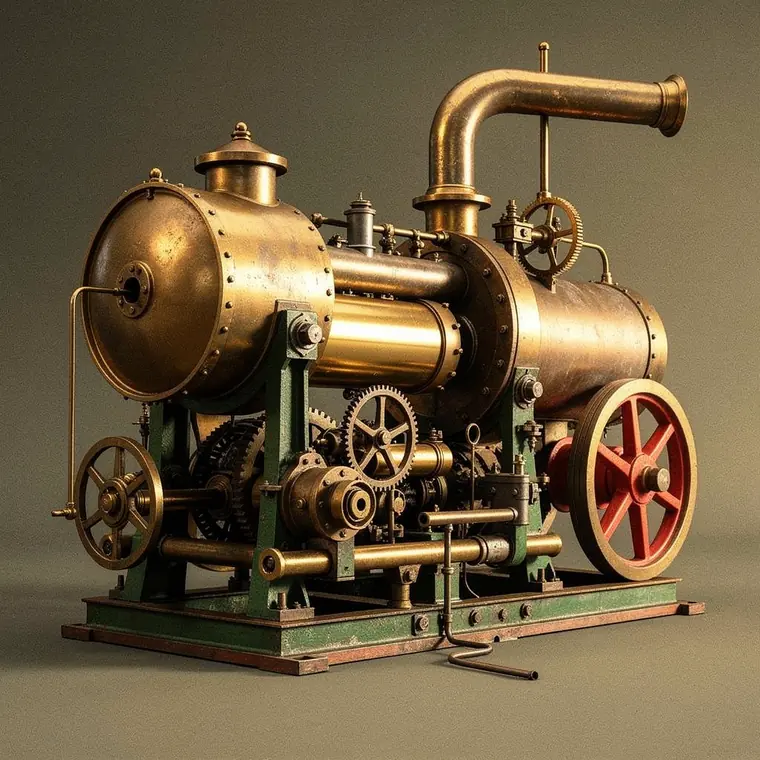
Trevithick's compact high-pressure engine, cylinder embedded in the boiler shell, exhaust discharging straight to the air through a short pipe.
- What it was used for
- On 21 February 1804 a high-pressure engine on wheels hauled ten tons of iron in five wagons, with seventy men riding on them, from the Penydarren ironworks to the canal at Abercynon. Trevithick wrote the next day that the distance was "above 9 miles", covered in four hours five minutes, that the engine while working went "nearly 5 miles pr hour" and burned two hundredweight of coal. The occasion was a wager of 500 guineas among the Merthyr ironmasters; sources disagree about who bet whom. The same boilers otherwise worked stationary, for instance as pumping engines.
- What was new
- Watt's engines worked barely above atmospheric pressure. An account of 1803 says ordinary engines, Watt's included, seldom worked at more than 5 lb per square inch, while Trevithick's were "sometimes equal to 60 pounds". High pressure without a separate condenser meant much power in little engine, small and light enough to carry itself. Oliver Evans was building high-pressure engines in Philadelphia at the same time; who was first cannot be settled cleanly. The price had already been paid: on 8 September 1803 the boiler of a Trevithick engine burst at Greenwich; the contemporary report says three men were killed on the spot and three more badly hurt, two of them not expected to live. And the locomotive of 1804 was too heavy for the cast-iron rails - whether the wager was ever paid is not known; it ended as a stationary engine driving a forge hammer.
Connections
Every connection names its kind. “Forerunner” on its own would be a claim.
- Made possibleSalamanca1812The Middleton locomotive of 1812 had to carry its own engine, and only high-pressure steam without a condenser made it light enough. The Science Museum says of Blenkinsop's rack locomotive that the arrangement of the engines was based on those built by Trevithick.Source: Science Museum Group Collection: Model of Blenkinsop rack locomotive ('The arrangement of the engines was based on those built by Trevithick')
- Made possibleRocket1829Trevithick and Vivian patented the high-pressure, non-condensing engine in 1802. The Science Museum: high-pressure engines were more compact than their predecessors, making the application of steam in the form of railway locomotives practicable. That holds for the class of engine; none of the sources says the Stephensons had Trevithick's engine before them.Source: Trevithick's High Pressure Steam Engine and Boiler, c. 1806 (Science Museum Group Collection) · Stephenson's Rocket, Rainhill and the rise of the locomotive (National Railway Museum)
Further reading
- Amgueddfa Cymru / National Museum Wales: Richard Trevithick's steam locomotive (Strecke, Last, siebzig Männer, zu schwer für die Schienen)
- Industrial Railway Society, Archives: Penydarren (Trevithicks Brief vom 22. Februar 1804 im Wortlaut)
- Grace's Guide: Richard Trevithick, Greenwich Explosion (Newcastle Courant, 24. September 1803)