Alum Bay Station
1897 · Spark Wireless Station · Work 149 of 1,871
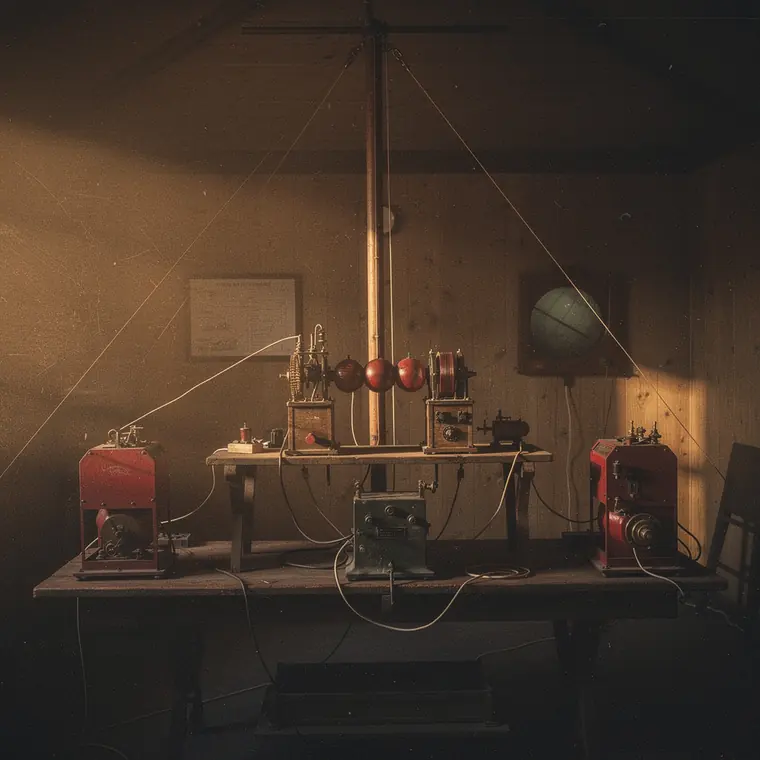
The Marconi station at the Needles hotel above Alum Bay, a tall wooden mast with a single aerial wire dropping to a hut where an induction coil, spark oscillator and inker stand on a table.
- What it was used for
- Marconi took rooms in the Royal Needles Hotel above Alum Bay and converted the billiard room into a sending station; the proprietors welcomed a winter guest in the dead season. Cleveland Moffett, who visited the station for McClure's Magazine, described in June 1899 two men in the little sending-room, one of them working a black-handled key up and down while inch-long bluish sparks jumped between two brass knobs. The real work was done at sea: Marconi and George Kemp put out in a tug with the receiver on a sixty-foot mast to find where the signal failed - for months, through storm and gale. The shore stations opposite were Bournemouth, fourteen miles off, and from late 1898 the Haven Hotel at Poole, eighteen miles.
- What was new
- What was new was not wireless but continuous operation: a fixed station handling regular traffic over water in all weathers, instead of single demonstrations. That it was the world's first permanent wireless station is claimed by Marconi himself, per the 1940 memorial inscription, by Tim Wander and by Dorset Life. The figures diverge: Moffett gives a 120-foot mast for November 1897, Wightpedia gives 168 feet, Dorset Life 115. Commander Hornby observed ten words a minute over 14.5 miles on 7 May 1898. The barb is Marconi's own arithmetic. Moffett asked whether a mast of 160 feet would then send eighty miles; Marconi answered "Exactly", and concluded that with a second Eiffel Tower in New York, messages to Paris would be possible. The proportion did not even hold on the spot: Moffett reports that they were now sending with a sixty-foot conductor where 120 feet had been needed at first. He reached the Atlantic on a false proportion.
Connections
Every connection names its kind. “Forerunner” on its own would be a claim.
- Follows fromHertz Spark Apparatus1887The sender at Alum Bay was a Hertz exciter on an aerial wire. Moffett watched the sparks between the brass knobs of the induction coil in 1899 and was told: these are Hertzian waves. Lodge describes Marconi's Dover station of 1899 - Ruhmkorff coil, one pole to earth, one to the aerial - and calls it identical with the signalling used by everyone since Hertz; only earth and wire replace the plates.Source: Cleveland Moffett, Marconi's Wireless Telegraph, McClure's Magazine, Juni 1899 (Transkription earlyradiohistory.us): Induktor, Funken, 'These are Hertzian waves' · Oliver J. Lodge, Signalling Across Space Without Wires, 3. Aufl., S. 66-72: Marconis Anlage in Dover 1899 ('identical with that employed by everyone since the time of Hertz')
- Follows fromBranly Coherer1890The receiver is Branly's tube made small. Lodge writes that Marconi improved the early form of Branly's filings tube: greatly reduced in size, terminals brought closer, fine filings for coarse borings, sealed in a vacuum. Moffett saw exactly this tube at Alum Bay in 1899, nickel and silver dust between two silver plugs; the ETHW records that Marconi was careful to credit Branly.Source: Oliver J. Lodge, Signalling Across Space Without Wires, 3. Aufl., S. 45-48 ('improving the early form of Branly filings tube') · Cleveland Moffett, Marconi's Wireless Telegraph, McClure's Magazine, Juni 1899 (Transkription earlyradiohistory.us): der Coherer in Alum Bay · Engineering and Technology History Wiki (IEEE): Coherer ('Marconi was careful to credit Branly') · IEEE Milestone (ETHW): Discovery of Radioconduction by Edouard Branly, 1890 ('used by, amongst others, Guglielmo Marconi, in his early experiments')
- Follows fromMorse Register1844At the end of the wireless link stood a Morse recorder. Moffett describes in 1899 how at Alum Bay the wheels of a Morse printing-apparatus began to turn, registering dots and dashes on a moving tape. Lodge explains the circuit: the same current that works the tapper works the Morse instrument alongside and records a short or long signal on the tape. Wireless replaced the wire, not the writing.Source: Cleveland Moffett, Marconi's Wireless Telegraph, McClure's Magazine, Juni 1899 (Transkription earlyradiohistory.us): 'the wheels of a Morse printing-apparatus straightway began to turn' · Oliver J. Lodge, Signalling Across Space Without Wires, 3. Aufl., S. 66-72: Marconis Empfänger 1899 (Relais, Klopfer, Morse-Instrument auf dem Tisch daneben)
Further reading
- Cleveland Moffett, Marconi's Wireless Telegraph, McClure's Magazine, Juni 1899, S. 99-112 (Transkription earlyradiohistory.us)
- History of Science Museum, Oxford (Marconi Collection): Wireless World - Seaside Trials
- The Dreadnought Project: British Adoption of Radio Communication, zitiert Annual Report of the Torpedo School, 1898, App. D, S. 134-135
- Wightpedia: Marconi Memorial, Alum Bay (Denkmal von 1940, Betriebsdaten 6.12.1897 bis 26.5.1900)
- Tim Wander (marconibooks.co.uk): Marconi on the Isle of Wight (Billardzimmer des Needles Hotel als Station; 'first permanent wireless station')
- Dorset Life: Something in the air (Haven Hotel, Sandbanks, ab 30. September 1898; Mast 115 Fuß)