Cornish Beam Engine
1812 · Pumping Engine · Work 91 of 1,871
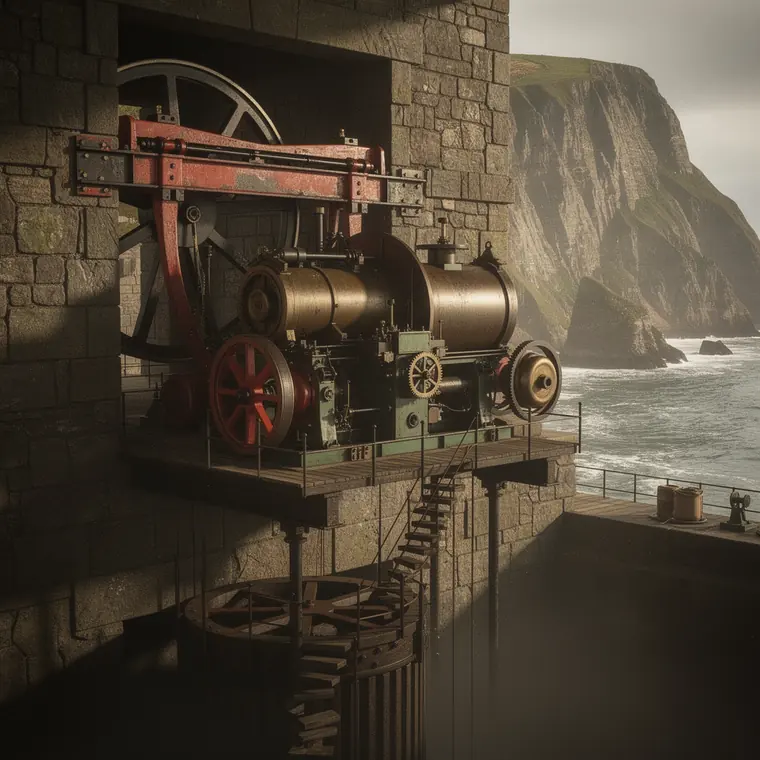
A Cornish pumping engine in its granite engine house above a mine shaft, beam projecting through the bob wall, pump rods descending into darkness, Atlantic cliffs beyond.
- What it was used for
- It pumped water out of the tin and copper mines of Cornwall. Trevithick's 1812 engine at Wheal Prosper used a second-hand 610 mm cylinder, reputedly from the Relistian tin mine and a boiler carrying over 276 kN/m2 above atmosphere; it worked three sets of pumps at depths of 36.6, 36.6 and 18.3 metres. Cornwall had no coal of its own. It came by sea from Bristol and South Wales, and mule carriage from the port to the mine, according to the World Heritage Site, often cost as much again. Economy here was not a virtue but arithmetic. From 1837 waterworks adopted the type as well: the Grand Junction Waterworks 90-inch engine at Kew, built in 1846, beam of 32 tons, lifted 472 gallons a stroke and, at the last, 6.4 million gallons a day - and did so until 1943. The man whose engine, by his own account, did nearly double the duty went bankrupt in 1811, a year before Wheal Prosper, and died penniless in 1833. The mine closed in 1837; what became of his two engines is unknown.
- What was new
- What was new was not the beam but the joining of two things previously kept apart: working high-pressure steam expansively and still condensing it. Trevithick's biographer in 1872 names two innovations in his first Wheal Prosper engine of 1811, the plunger-pole engine - the boiler that supplied high-pressure steam safely, and the plunger pole in place of a piston, expressly also because it could be built by mechanics without slide lathes or planing machines. At the same time Arthur Woolf was working on the compound engine in Cornwall. The duty figures of those years must be read with care: the 40 millions claimed for the Wheal Prosper pole engine come from a letter by Trevithick himself of 26 January 1813, and the reference unit varies between the Cornish bushel of 84 lb and Watt's bushel of 112 lb.
Connections
Every connection names its kind. “Forerunner” on its own would be a claim.
- Follows fromTrevithick High-Pressure Engine1800The Cornish engine works steam at a pressure that only Trevithick's Cornish boiler delivered safely, and cuts it off early so that it expands. The World Heritage Site account calls his influence on mine engines considerable, "particularly following the introduction of his high-pressure 'Cornish' boiler".Source: Cornish Mining World Heritage Site / Cornwall Council: Richard Trevithick (1771-1833) and the Cornish Engine (PDF) · Encyclopaedia Britannica: Cornish engine (von Trevithick mit örtlichen Ingenieuren vervollkommnet, doppelt so sparsam wie die Watt-Bauart)
- Follows fromWatt Separate Condenser1769Selgin and Turner call the Cornish engine a hybrid: made from condensing Boulton & Watt engines converted to use moderately high-pressure steam of about 40 psi. The condenser stays: the steam above the piston expands while the ejected steam below cools in the condenser and draws a vacuum. Trevithick's puffer, by contrast, did without a condenser.Source: George Selgin und John Turner, Strong Steam, Weak Patents, Arbeitspapier vom 8. April 2009, Fußnote 12 und Abschnitt zur Umrüstung in Cornwall · Bernard Deacon, What was a Cornish engine? (Cornish studies resources)
- Works withCrowns Engine Houses1835The lower of the two Crowns houses at Botallack held a pumping engine. House and engine are one thing: the bob wall of cut granite carries the beam, possibly over 50 tons on a large pumping engine, and the other walls brace it against the rocking forces.Source: Cornwall Heritage Trust, Cornwall For Ever!: The Crowns (unteres Haus Pumpmaschine, oberes Haus Fördermaschine; Häuser der 1830er und 1860er Jahre) · Cornish Mining World Heritage Site: Engine Houses (Bob-Wand aus behauenem Granit, trägt den Balancier, über 50 Tonnen, übrige Wände steifen sie aus)